
In This Article
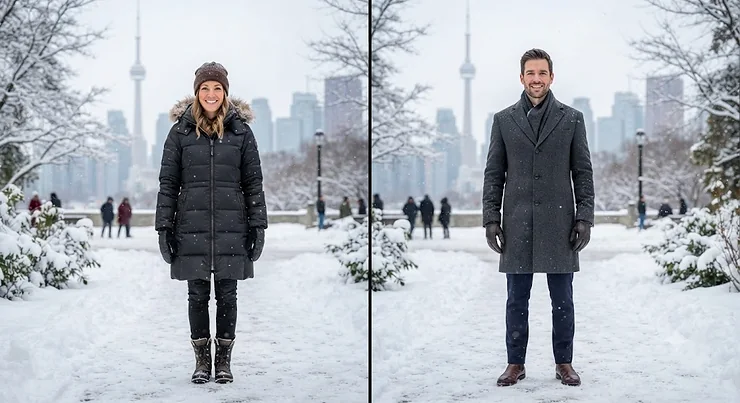
Standing in a store aisle staring down a rack of shiny nylon puffers on one side and structured wool overcoats on the other is basically a Canadian rite of passage. A puffer coat vs wool coat for winter decision usually comes down to this: puffer coats trap heat using synthetic or down insulation sealed between quilted nylon panels, while wool coats rely on tightly woven natural fibres that insulate through density and moisture-wicking structure rather than trapped air pockets. Neither one is objectively “better” — they’re built for different jobs, different commutes, and different relationships with -20°C wind chill.

This matters more in Canada than almost anywhere else, because our winters don’t play fair. A dry, still -15°C day in Alberta feels completely different from a damp, windy -5°C evening in Halifax, and Environment and Climate Change Canada’s wind chill index exists specifically because temperature alone doesn’t tell you how a coat will actually perform on your skin. That’s the real question buyers should be asking, not “which coat is more expensive” or “which one looks nicer on Instagram.”
Below, we’ve pulled together seven real, currently available coats — a mix of budget, mid-range, and premium options in both categories — and broken down exactly where each one shines and where it falls apart. We’ll also walk through insulation science, fit mistakes, commuting-specific advice, and a full breakdown of coat vs jacket vs parka terminology that gets misused constantly. By the end, you’ll know exactly which side of the puffer coat vs wool coat for winter debate your closet actually needs — and maybe why the honest answer is “one of each.”
Puffer Coat vs Wool Coat: Quick Comparison Table
Before we get into individual products, here’s the fast version for anyone who just wants the gist. This table compares the two coat categories broadly, not a specific product — the product-by-product comparison comes next.
| Factor | Puffer Coats | Wool Coats |
|---|---|---|
| Warmth-to-weight ratio | Excellent — high loft traps heat without bulk | Good, but heavier per degree of warmth |
| Wind resistance | Strong (tight nylon shells block wind well) | Moderate (wool breathes, so wind cuts through faster) |
| Wet-snow performance | Varies — down clumps if soaked, synthetic holds up | Strong — wool insulates even damp, sheds light snow |
| Best for | Extreme cold, active commutes, layering | Office wear, tailored looks, damp coastal cold |
| Typical price range | C$80–C$330 | C$70–C$260 |
| Longevity | 3–7 years with care | 7–15+ years with care |
Looking at the numbers here, the split isn’t really about which coat is “warmer” in a lab sense — it’s about matching the coat’s weaknesses to your actual weather. Puffer coats win decisively in dry, brutally cold, wind-exposed conditions where trapped air is king, while wool coats hold their ground better in the damp, temperature-hovering-near-zero conditions common in cities like Vancouver, Toronto, or Halifax. Longevity is where wool quietly pulls ahead — a well-made wool coat with proper care can outlast three or four puffer coats, which changes the long-term cost math we’ll dig into later.
💬 Just one click — help others make better buying decisions too!😊
Top 7 Winter Coats: Puffer and Wool, Expert Analysis
We picked seven real, purchasable coats spanning budget, mid-range, and premium tiers in both categories. Each one gets an honest breakdown of who it’s actually for — not just a spec dump.
1. Orolay Women’s Puffer Down Coat (Cloak-Type) — the internet-famous “Amazon coat”
The standout here isn’t a spec — it’s cultural: this is the coat that earned its own Wikipedia entry as the “Amazon coat” after going viral for years running. Underneath the internet fame, it’s a down-filled, thigh-to-knee-length cloak-style coat with a drawstring waist, stand collar, and roomy through the shoulders — a cut designed to layer over sweaters without feeling restrictive. The down fill (blended with feather in most listings) is genuinely warm in dry cold, and the oversized cut means it works over bulky knitwear rather than fighting it.
Based on the shape and fill type, this is squarely a commuter and errand-running coat rather than a technical outdoor piece — it’s not built for hiking or high-output activity, but for standing at a bus stop or walking a few city blocks in comfort. Aggregated review sentiment across marketplaces consistently praises the warmth-to-price ratio and the flattering cloak silhouette, while a recurring theme in the same reviews is that sizing runs generously, so buyers are often advised to size down from their usual fit.
Pros:
- ✅ Down fill delivers strong warmth for the price tier
- ✅ Oversized cloak cut layers easily over sweaters
- ✅ Wide size range and colour selection available
Cons:
- ❌ Bulky silhouette isn’t ideal for tailored or office looks
- ❌ Down fill loses some loft if it gets soaked
At a price point that typically lands in the C$110–C$170 range on Amazon.ca, the Orolay Women’s Puffer Down Coat remains one of the strongest value plays in the puffer category, especially for anyone who wants one coat to survive a full prairie or Ontario winter without technical outdoor pricing.

2. Amazon Essentials Men’s Wool-Blend Heavyweight Peacoat — best budget entry into wool
The standout feature is straightforward: it’s a genuinely classic double-breasted peacoat silhouette at a price point wool coats rarely hit. The wool-blend fabric (wool combined with synthetic fibres for durability and cost control) gives it structure and a smarter look than most coats in its price bracket, with a notch lapel and mid-thigh length that splits the difference between a jacket and a full overcoat.
What the spec sheet won’t tell you is that wool-blend coats like this trade a bit of pure insulating power for durability and a cleaner drape — the blend resists pilling and holds its shape through repeated wear better than 100% wool would at this price. It’s best suited to buyers who need one coat that works for both a daily commute and an occasional dressier occasion, rather than someone facing sustained sub-minus-20°C exposure. Aggregated customer sentiment on Amazon tends to flag the coat as surprisingly well-tailored for the price, with the most common complaint being that the wool-blend runs a touch thin for the coldest weeks of deep winter without a layer underneath.
Pros:
- ✅ Classic peacoat tailoring at an unusually low price point
- ✅ Wool blend resists pilling better than cheaper synthetics
- ✅ Versatile enough for both office and casual wear
Cons:
- ❌ Needs a warm layer underneath for extreme cold snaps
- ❌ Blend fabric feels less premium than higher-wool-content coats
Priced roughly C$70–C$110, the Amazon Essentials Men’s Wool-Blend Heavyweight Peacoat is the easiest low-risk way to test whether the wool side of this debate suits your lifestyle before committing to a pricier option.
3. Columbia Men’s Powder Lite Jacket — best packable puffer under C$150
The standout advantage is packability: Columbia’s proprietary synthetic insulation compresses down small enough to stuff into a bag, which matters enormously for anyone who moves between indoor and outdoor environments all day. The shell uses a water-resistant finish rather than a fully waterproof membrane, so it sheds light snow and drizzle without soaking through in a quick walk to the car.
In practice, synthetic insulation like this behaves differently from down in one crucial way: it keeps insulating even when damp, because the synthetic fibres don’t clump together the way down clusters do when wet. That makes it a smarter pick than a down puffer for anyone dealing with wet snow rather than dry powder — think Vancouver Island or the Maritimes more than the Prairies. Reviewers consistently note the jacket runs true to size and layers well, though a repeated theme in aggregated feedback is that it’s better suited to brisk cold than truly extreme temperatures, since the insulation is intentionally lightweight rather than heavyweight.
Pros:
- ✅ Synthetic insulation still warms you when it gets wet
- ✅ Packs down small for travel or variable indoor days
- ✅ Water-resistant shell handles light snow and drizzle
Cons:
- ❌ Not heavyweight enough for sustained extreme cold alone
- ❌ Shell isn’t fully waterproof in sustained heavy rain
Sitting around C$90–C$140, the Columbia Men’s Powder Lite Jacket earns its spot as the go-to budget puffer for damp, moderately cold Canadian regions rather than the deep-freeze provinces.
4. London Fog Men’s Signature Wool Blend Top Coat — best classic tailored topcoat
The standout here is silhouette: a single-breasted, notch-lapel topcoat cut long enough to layer over a suit jacket without bunching, which is exactly the gap most puffer coats can’t fill. The wool-blend construction, typically finished with a satin lining, gives it a smoother drape than heavier peacoats, making it the more office-appropriate of the wool options on this list.
The practical trade-off is warmth ceiling: a tailored topcoat like this is built to look sharp over business attire, not to replace a heavyweight parka on the coldest days of the year. Based on the construction and typical fill weight for this category, it performs best in the -5°C to -15°C range with a sweater underneath, rather than sustained deep-freeze conditions. Aggregated review sentiment frequently highlights the tailored fit and lining quality as punching above the price point, while a recurring critique is that sizing can run slightly narrow through the shoulders for buyers who layer heavily underneath.
Pros:
- ✅ Tailored, professional silhouette suits business settings
- ✅ Satin lining adds a premium feel for the price
- ✅ Longer cut layers cleanly over suit jackets
Cons:
- ❌ Shoulder fit can run narrow for heavy layering
- ❌ Not warm enough alone for extreme cold snaps
At roughly C$150–C$210, the London Fog Men’s Signature Wool Blend Top Coat is the strongest pick here for anyone whose winter coat also needs to double as business-appropriate outerwear.
5. The North Face Men’s ThermoBall Eco Jacket 2.0 — best synthetic-down hybrid
The standout feature is ThermoBall Eco insulation itself — small clustered pockets of synthetic fill engineered to mimic the loft pattern of real down, built from recycled materials. That clustering matters because it’s what gives synthetic insulation down-like compressibility and warmth-to-weight performance instead of the flatter, denser feel older synthetic fills had.
Based on the spec comparison with true down jackets, this hybrid approach closes most of the warmth gap while keeping the “still insulates when wet” advantage synthetic fill offers over feather down — a meaningful edge for anyone dealing with wet snow, slush, or unpredictable coastal precipitation. It’s a strong match for commuters who want backpack compatibility (it packs into its own internal pocket) and don’t want to babysit a delicate down garment. Reviewers consistently praise the packability and the water-repellent finish, while a common theme in feedback is that the fit runs slim, pushing some buyers toward sizing up for room to layer.
Pros:
- ✅ ThermoBall Eco insulation stays warm even when damp
- ✅ Packs into its own pocket for travel or transit
- ✅ Water-repellent finish handles wet snow well
Cons:
- ❌ Slim fit means limited room for heavy layering
- ❌ Pricier than most synthetic-fill competitors in its class
Typically found in the C$220–C$280 range, the The North Face Men’s ThermoBall Eco Jacket 2.0 is the smartest synthetic pick for buyers who want down-like performance without down’s wet-weather weaknesses.

6. Calvin Klein Women’s Classic Wool Blend Coat — best premium wool-cashmere blend
The standout feature is the cashmere-blend fabric, which adds a noticeably softer hand-feel and a more refined drape than standard wool-blend coats, paired with a tailored single-breasted cut and notch collar. This is the coat built for buyers who want their winter outerwear to read as polished rather than purely functional.
The cashmere content genuinely changes performance, not just texture — cashmere fibres are finer than standard wool, which traps more still air per gram of fabric and produces a noticeably warmer coat than a comparably weighted pure wool-blend piece. What most buyers overlook is that this warmth advantage still has limits against wind; like most wool coats, it performs best paired with a scarf and gloves once temperatures drop into seriously cold territory, rather than as a standalone extreme-weather shield. Aggregated customer sentiment tends to single out the fabric quality and tailored fit as standout strengths, with the most consistent critique being that the coat requires more careful, dry-clean-only maintenance than wool-blend alternatives.
Pros:
- ✅ Cashmere blend adds noticeable extra warmth and softness
- ✅ Tailored fit flatters a wide range of body types
- ✅ Elevated look works for both office and evening wear
Cons:
- ❌ Requires dry cleaning rather than at-home washing
- ❌ Premium price compared to standard wool-blend coats
Generally priced C$190–C$260, the Calvin Klein Women’s Classic Wool Blend Coat is the strongest premium choice for buyers prioritizing polish and warmth together over pure technical performance.
7. Marmot Men’s Guides Down Hoody — best true down for extreme cold
The standout spec is genuine high fill-power down (commonly 700-fill in this model line), treated with a water-resistant finish often branded as Down Defender to address down’s single biggest weakness. Fill power measures the loft — how much space an ounce of down expands to fill — and higher numbers mean more trapped warm air per gram of material, which is why this jacket punches well above its visible bulk.
This is the jacket built for people who actually need extreme-cold performance rather than urban styling: dog walkers in rural Manitoba, ice fishers, or anyone regularly exposed to sustained sub-minus-20°C conditions in dry cold. The attached hood and ripstop nylon shell round out a genuinely technical package rather than a fashion-first puffer. Reviewers consistently describe the warmth as excellent for its weight, and the water-resistant down treatment gets specific praise for holding performance through light snow exposure — though a repeated caution in feedback is that, like all down, prolonged heavy wetting still degrades loft faster than synthetic fill would.
Pros:
- ✅ High fill-power down delivers exceptional warmth-to-weight ratio
- ✅ Water-resistant down treatment reduces down’s classic weak point
- ✅ Attached hood adds real protection in wind and snow
Cons:
- ❌ Premium pricing compared to synthetic-insulated alternatives
- ❌ Heavy sustained wetting still degrades performance over time
At around C$270–C$330, the Marmot Men’s Guides Down Hoody is the clear pick for anyone whose winters genuinely demand technical, extreme-cold-rated performance rather than city-commute styling.
Puffer Coat vs Wool Coat for Winter: Quick Product Recap
| Coat | Type | Best For | Price Range |
|---|---|---|---|
| Orolay Women’s Puffer Down Coat | Puffer (down) | Everyday city warmth, oversized layering | C$110–C$170 |
| Amazon Essentials Wool-Blend Peacoat | Wool blend | Budget entry into wool styling | C$70–C$110 |
| Columbia Powder Lite Jacket | Puffer (synthetic) | Wet, moderately cold regions | C$90–C$140 |
| London Fog Signature Wool Blend Top Coat | Wool blend | Business-appropriate warmth | C$150–C$210 |
| The North Face ThermoBall Eco Jacket 2.0 | Puffer (synthetic) | Commuters wanting down-like performance | C$220–C$280 |
| Calvin Klein Classic Wool Blend Coat | Wool-cashmere blend | Polished, premium everyday wear | C$190–C$260 |
| Marmot Guides Down Hoody | Puffer (down) | Extreme, sustained dry cold | C$270–C$330 |
Scanning this side by side, the pattern holds up: puffer coats dominate the extreme-cold and wet-weather-resilience categories, while wool coats dominate anywhere professional appearance matters as much as warmth. Price doesn’t map cleanly to warmth either — the mid-priced Columbia Powder Lite Jacket is arguably better suited to wet Canadian coastal winters than the pricier Calvin Klein Classic Wool Blend Coat, simply because of how each material behaves when soaked.
Practical Care & Maintenance Guide
Getting the warmth numbers right on paper doesn’t matter much if the coat falls apart by February. Down-filled puffers like the Marmot Guides Down Hoody need occasional specialty down-wash cycles (never regular detergent, which strips the natural oils that help down loft) and should be tumble-dried on low with clean tennis balls to redistribute clusters after washing. Synthetic puffers like the Columbia Powder Lite Jacket and The North Face ThermoBall Eco Jacket 2.0 are more forgiving — most can go through a gentle machine cycle — but should still air dry fully before storage to avoid mildew inside the insulation layer.
Wool coats play by different rules entirely. The Amazon Essentials Men’s Wool-Blend Heavyweight Peacoat and similar blends can often handle a steamer for wrinkle removal and occasional spot-cleaning, but anything with higher wool or cashmere content — like the Calvin Klein Women’s Classic Wool Blend Coat — genuinely needs dry cleaning to avoid shrinkage and felting. A common first-30-days mistake is hanging a wet wool coat directly in a closet; instead, let it air dry on a wide wooden hanger away from direct heat, which prevents the fibres from stretching out of shape. For any coat, storing it compressed for months (stuffed in a bin) is the fastest way to kill loft and structure — hang, don’t pack, whenever closet space allows.
Ready to stop guessing and start comparing real options? Check current availability and pricing below! ✨
Real-World Scenarios: Which Coat Actually Fits Your Winter
Consider a university student in Waterloo who bikes to campus and back most days regardless of temperature. For that profile, a synthetic puffer like the Columbia Powder Lite Jacket makes more sense than a tailored wool coat — it handles sweat and unpredictable slush better, doesn’t need dry cleaning on a student budget, and layers easily under a backpack without the bulk of down.
Now picture a downtown professional in Calgary who walks two blocks from a parkade to an office building and spends most of the day indoors. Extreme insulation is overkill here; the London Fog Men’s Signature Wool Blend Top Coat or Calvin Klein Women’s Classic Wool Blend Coat fits the actual exposure level while looking appropriate in client meetings — paying for Marmot-level extreme-cold protection would be solving a problem this person doesn’t have.
Finally, think about someone in rural Saskatchewan who’s outside for extended stretches doing chores or dog-walking through -25°C dry cold. That’s exactly the use case the Marmot Men’s Guides Down Hoody was engineered for — high fill-power down and a hood aren’t styling choices there, they’re the difference between comfortable and genuinely at risk. Matching the coat to actual time-outdoors and moisture exposure, not just the thermometer, is the single biggest factor separating a happy buyer from a disappointed one.
Problem → Solution: Fixing Common Winter Coat Complaints
Problem: “My puffer coat isn’t warm enough for how cold it actually gets.” This usually means the fill type or amount doesn’t match the exposure level — a lightweight synthetic puffer built for commuting isn’t meant to substitute for a high fill-power down coat like the Marmot Guides Down Hoody during extended outdoor exposure. Solution: match fill power and insulation weight to actual time spent outside, not just the general climate of your city.
Problem: “My wool coat gets soaked and stays cold in wet snow.” Wool insulates reasonably well even when damp, but a soaking-wet coat still loses significant warmth and takes hours to dry. Solution: treat wool coats with a fabric protector spray at the start of the season, and reserve them for shorter exposure windows rather than all-day wet-snow conditions.
Problem: “My puffer coat looks too casual for work.” This is a styling mismatch, not a warmth problem — solution is simply choosing a wool-blend topcoat like the London Fog Men’s Signature Wool Blend Top Coat for office days and saving the puffer for weekends and commutes.
Problem: “My down jacket lost its loft after one winter.” This is almost always a washing or storage issue — down needs specialty detergent and full drying, and should never be compressed for long-term storage. Following the specialty care routine outlined above typically restores most of the lost loft.

Buyer’s Decision Framework: If This, Choose That
Use this simple priority checklist when the puffer coat vs wool coat for winter decision feels stuck:
- If you’re outdoors for more than 30 minutes at a stretch in dry cold, choose a high fill-power down puffer like the Marmot Guides Down Hoody.
- If you deal with wet snow or coastal damp more than dry powder, choose a synthetic puffer like the Columbia Powder Lite Jacket or The North Face ThermoBall Eco Jacket 2.0.
- If your coat needs to look professional in an office or client-facing setting, choose a tailored wool coat like the London Fog Men’s Signature Wool Blend Top Coat.
- If budget is the primary constraint, start with the Amazon Essentials Men’s Wool-Blend Heavyweight Peacoat or the Orolay Women’s Puffer Down Coat, both of which deliver disproportionate value for their price tier.
- If you want one coat that balances warmth and polish without technical bulk, choose a wool-cashmere blend like the Calvin Klein Women’s Classic Wool Blend Coat.
Puffer Coat vs Wool Coat for Winter: Insulation Types Compared
Insulation types compared side by side reveal why this debate doesn’t have a universal winner. Down insulation — used in the Orolay Women’s Puffer Down Coat and Marmot Guides Down Hoody — works by trapping air between fine, clustered plumule fibres, and the more those clusters loft, the more warm air gets trapped per gram of material, which is what fill-power numbers actually measure. The catch is that down clusters collapse when wet, dramatically reducing insulating power until they dry out again.
Synthetic insulation, found in the Columbia Powder Lite Jacket and The North Face ThermoBall Eco Jacket 2.0, uses polyester fibres engineered to mimic down’s clustering structure. It’s typically heavier for the same warmth level, but it keeps insulating even when soaked, since the fibres themselves don’t absorb water the way natural down does. Wool, meanwhile, works through an entirely different mechanism: its fibres are naturally crimped and scaled, trapping air within the fibre structure itself rather than in a loose fill layer, which is why wool retains meaningful insulating properties even when damp — a genuine structural advantage over both down and synthetic fill in borderline-wet conditions. Practically speaking, this is why the Calvin Klein Women’s Classic Wool Blend Coat stays comfortable in light drizzle in a way an untreated down coat simply can’t.
Coat vs Jacket vs Parka: What’s Actually the Difference
The coat vs jacket vs parka question comes up constantly, and the terms get used interchangeably even though they describe genuinely different garments. A jacket is generally shorter — hitting at or above the hip — and lighter-duty, which describes most puffer options like the Columbia Powder Lite Jacket. A coat typically extends to the thigh or knee and implies more structure or formality, which fits both the London Fog Men’s Signature Wool Blend Top Coat and the longer cut of the Orolay Women’s Puffer Down Coat.
A parka is a specific subtype: a hip-to-knee-length, hooded, heavily insulated garment originally designed by Arctic Indigenous peoples and adapted for extreme-cold military and outdoor use — the Marmot Men’s Guides Down Hoody, with its attached hood and technical insulation, sits closest to modern parka territory even though it’s marketed as a jacket. Understanding this distinction matters practically: a “jacket” advertised for -30°C performance deserves scrutiny, since true parka-level protection usually requires the length and hood coverage that shorter jacket cuts don’t provide. When comparing listings, treat the coat vs jacket vs parka labels as loose marketing language and check the actual length, hood, and insulation weight instead.
Winter Coat Fit Guide: How Your Coat Should Actually Fit
A winter coat fit guide has to start with layering room, because the biggest fit mistake buyers make is sizing a winter coat the same way they’d size a t-shirt. The coat needs enough room through the chest and shoulders to comfortably fit a sweater or mid-layer underneath without compressing the insulation — compressed insulation, whether down or synthetic, loses loft and therefore loses warmth, which defeats the purpose of buying a warm coat in the first place.
Sleeve length matters more than most buyers expect: sleeves should extend past the wrist bone even with arms raised, since a gap there is a direct entry point for cold air and snow. For puffer coats specifically, check that the cuffs have some form of closure — elastic, rib-knit, or a snap — rather than a loose open hem. For wool coats like the Calvin Klein Women’s Classic Wool Blend Coat, the shoulder seam should sit right at the natural shoulder point, not drooping past it, since wool doesn’t have the forgiving stretch that puffer shells often provide. Length is the last check: a coat that stops mid-thigh protects less core warmth than a knee-length option, which is worth factoring in if you’re regularly outdoors for extended periods rather than quick transit walks.
Top Winter Coats for Commuting in Canada
Top winter coats for commuting need a specific combination of traits that neither a purely technical mountaineering jacket nor a purely fashion-forward coat always delivers: packability for transit, wind resistance for exposed platforms and bus stops, and enough room to layer without looking bulky under a work bag’s straps. Based on the products covered here, The North Face ThermoBall Eco Jacket 2.0 stands out specifically for commuters because it packs into its own pocket for warm indoor stretches and its water-repellent shell handles the slush kicked up by traffic and transit.
For commuters who split time between transit and office meetings, the London Fog Men’s Signature Wool Blend Top Coat solves a different commuting problem — looking presentable the moment you walk in, without needing to change out of outerwear. And for anyone whose commute includes actual biking or extended walking rather than just transit stops, the Orolay Women’s Puffer Down Coat‘s roomy cut accommodates a backpack and layers underneath without restricting movement, which matters more on a moving bike than it does standing at a bus shelter.

How to Choose Between a Puffer Coat and a Wool Coat
- Identify your actual outdoor exposure time. Ten minutes between a car and a building calls for different insulation than an hour-long dog walk.
- Factor in your regional moisture profile. Dry-cold provinces favour down; damp coastal regions favour synthetic fill or wool.
- Decide how much the coat needs to double as professional wear. If yes, lean wool; if it’s purely functional, lean puffer.
- Check your budget against realistic lifespan. A wool coat’s higher upfront cost often amortizes better over 8–10 years than replacing puffers more frequently.
- Consider your layering habits. Frequent heavy layering needs roomier puffer cuts; minimal layering suits tailored wool silhouettes better.
- Think about maintenance tolerance. Dry-clean-only wool blends demand more upkeep than machine-washable synthetic puffers.
- Match hood and closure needs to actual wind exposure. Exposed commutes benefit from a hood; short walks generally don’t need one.
Working through these seven questions in order tends to produce a clearer answer than agonizing over marketing claims, since it forces the decision back to your actual daily routine rather than abstract warmth ratings.
Long-Term Cost & Maintenance: Which Coat Wins Over Five Winters
| Cost Factor | Puffer Coat (avg.) | Wool Coat (avg.) |
|---|---|---|
| Typical lifespan | 3–7 years | 7–15+ years |
| Cleaning cost per year | Low (often machine-washable) | Moderate–high (dry cleaning) |
| Replacement frequency over 10 years | 2–3 coats | 1 coat |
| Repair viability | Limited (fill leaks, shell tears) | Good (tailoring, relining) |
Run the math over a full decade and the picture shifts noticeably: even though a quality wool coat like the Calvin Klein Women’s Classic Wool Blend Coat costs more upfront than a budget puffer, its longer realistic lifespan and repairability often make it the better value over time, provided the dry-cleaning cost doesn’t outweigh those savings for someone who wears it daily. Puffer coats, by contrast, tend to lose loft and functional warmth gradually, meaning the “replacement” isn’t always a dramatic failure — just a slow decline that eventually makes buying a new one worthwhile. According to CBC Life’s breakdown of buying insulated layering pieces, understanding how a garment’s insulation degrades over repeated use is as important as its day-one warmth rating — advice that applies directly to both sides of this comparison.
Features That Actually Matter (And Those That Don’t)
Fill power and insulation weight matter enormously; a flashy “windproof” label on a coat’s tag matters far less, since almost every coat shell offers some wind resistance and the real differentiator is the tightness of the weave, not marketing language. A genuinely adjustable hood — one with drawcords rather than a fixed shape — matters a lot for anyone in exposed, windy areas, while decorative fur trim (real or faux) is almost entirely cosmetic and contributes negligible extra warmth despite often being marketed as a premium feature.
Pit zips and underarm venting matter for anyone who’s active in their coat, like commuters biking or walking briskly, since they prevent overheating and the resulting sweat that later turns cold. Interior pockets that seal (zippered or snapped) matter more than most buyers realize, since an open interior pocket in a puffer coat can let a phone slip against cold fabric and drain battery faster in freezing temperatures. On the wool side, a genuine wool percentage above 70% matters more for warmth and durability than lining pattern or branding, which is purely aesthetic and has zero impact on how the coat performs against actual Canadian winter weather.
Frequently Asked Questions
❓ Is a puffer coat or wool coat warmer for winter?
❓ Can you wear a wool coat in freezing temperatures?
❓ What temperature is a puffer coat good for?
❓ Is a puffer jacket the same as a puffer coat?
❓ How do I know if my winter coat is warm enough for Canadian winters?
Conclusion: So, Puffer Coat or Wool Coat for Winter?
There’s no single winner in the puffer coat vs wool coat for winter debate, and honestly, that’s the useful takeaway here — the “right” answer depends entirely on how much time you spend outside, how wet your regional winter tends to get, and whether your coat also needs to double as professional wear. Puffer coats, from the budget-friendly Orolay Women’s Puffer Down Coat to the extreme-cold-rated Marmot Guides Down Hoody, win on raw warmth-to-weight performance and dry-cold protection. Wool coats, from the accessible Amazon Essentials Men’s Wool-Blend Heavyweight Peacoat to the premium Calvin Klein Women’s Classic Wool Blend Coat, win on longevity, damp-weather resilience, and professional polish.
For many Canadians, the honest solution isn’t picking a side permanently — it’s owning one of each and choosing based on the day’s actual forecast rather than habit. Before buying either, revisit the wind chill guidance from earlier in this article so your coat choice lines up with real regional risk, not just general assumptions about “Canadian winter.” Whichever direction you lean, prioritize matching insulation type to your actual exposure and moisture conditions over chasing the highest price tag or trendiest silhouette.
✨ Don’t Miss These Exclusive Deals!
Take your winter wardrobe to the next level with these carefully selected coats. Click on any highlighted pick to check current pricing and availability. The right coat means warmer commutes, fewer sick days, and one less thing to dread about winter this year!
Recommended for You
- Canadian-Made Winter Parka Review: 7 Honest Picks for 2026
- Urban Winter Parka: 7 Best Picks for Canadian Men in 2026
- Expedition Parka for Extreme Cold: 7 Best Picks for 2026
Disclaimer: This article contains affiliate links. As an Amazon Associate, I earn from qualifying purchases. If you purchase products through these links, we may earn a small commission at no additional cost to you.
✨ Found this helpful? Share it with your friends! 💬🤗
