
In This Article
Somewhere between the moment you unzip a rain jacket in the store and the moment you actually get caught in a proper Vancouver downpour, a tiny number on the label starts to matter a lot. That number — usually something like 30D, 50D, or 80D — is the rain jacket denier, and it’s one of the quietest but most consequential specs on any waterproof shell. Most shoppers skim right past it, chasing the waterproof rating or the brand name instead, and then wonder six months later why the fabric at their pack straps has gone thin and shiny.
Denier isn’t marketing fluff. It’s a measurement of how thick the individual threads in a fabric are, and it quietly decides whether your jacket shrugs off a branch on the trail or a jostling commute on the GO Train, or whether it develops a hole by October. This guide breaks down what rain jacket denier actually means, how it relates to waterproofing, weight, and tear strength, and — because specs on a website are only half the story — walks through seven real jackets currently sold in Canada, from a sub-C$60 emergency shell to a mountaineering-grade hardshell that costs more than a plane ticket. By the end, you’ll be able to read a fabric spec sheet the way a gear reviewer does, not the way a marketing department wants you to.
What Is Rain Jacket Denier? A Quick Fabric Denier Guide
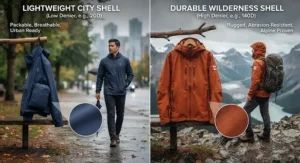
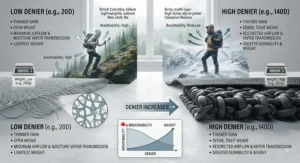
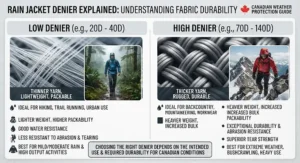
Rain jacket denier is a measurement of fabric thread thickness, expressed as “D” (for example, 40D or 70D), based on the weight in grams of 9,000 metres of yarn. In practical terms: the higher the denier, the thicker and more abrasion-resistant the fabric, but also the heavier and often less breathable it becomes.
This single number shows up on nearly every technical jacket’s spec sheet, whether it’s stitched into a hangtag at a Canadian outdoor shop or buried three clicks deep in an Amazon.ca listing. It doesn’t tell you whether a jacket is waterproof — that’s a separate rating called hydrostatic head — but it tells you how tough the outer layer feels and how long it’s likely to survive contact with a backpack strap, a bike pannier, or a rogue cedar branch. As the raincoat’s basic definition suggests, the whole point of this garment category is shielding the wearer from the elements, and denier is the fabric-side half of that promise; the waterproof membrane underneath is the other half.
Quick Comparison Table
| Jacket | Face Fabric Denier | Layer Construction | Best For |
|---|---|---|---|
| Frogg Toggs Xtreme Lite | Non-woven (no true denier rating) | 2-ply | Emergency backup, occasional wear |
| Columbia Watertight II | Unlisted, roughly 75D-class nylon | 2-layer | Casual everyday errands |
| Marmot PreCip Eco | ~50D-class recycled nylon ripstop | 2.5-layer | Budget hiking and travel |
| The North Face Venture 2 | 40D (solid) / 70D (heather) | 2.5-layer | Daily commuting and abuse |
| Helly Hansen Loke 2.0 | Lightweight ripstop polyamide | 2.5-layer | Wet, windy coastal conditions |
| Patagonia Torrentshell 3L | 50D recycled nylon ripstop | 3-layer | All-around hiking value |
| Arc’teryx Beta AR | 80D / 100D nylon | 3-layer GORE-TEX Pro | Mountaineering and ski touring |
Looking at the spread above, denier climbs steadily as you move from casual, low-cost shells toward mountain-specific hardshells, and price tends to climb right along with it. The Frogg Toggs Xtreme Lite and Columbia Watertight II sit at the accessible end where fabric weight is kept minimal to hit a low price point, while the Arc’teryx Beta AR‘s 80D-to-100D combination reflects a jacket engineered to survive years of ski-tour abuse rather than the occasional soggy dog walk. Notice, too, that denier alone doesn’t dictate layer count — a jacket can be light in denier but still built as a full 3-layer shell, which matters more than most shoppers realize once we get into waterproofing further down.
💬 Just one click — help others make better buying decisions too! 😊
Top 7 Rain Jackets: Expert Denier Breakdown
Amazon.ca’s catalogue is enormous, so we narrowed things down to seven jackets that actually publish real fabric specs and have a track record of independent testing — not just marketing copy. Each one below is broken down by what its denier and construction actually mean once you’re standing in the rain, not just what the label claims.
1. Frogg Toggs Xtreme Lite — lightest emergency shell with taped seams
The Frogg Toggs Xtreme Lite skips the denier conversation almost entirely, and that’s the point. Instead of a woven nylon or polyester face fabric, it uses a non-woven 2-ply polypropylene laminate, which is why you won’t find a “D” number on the label at all. In practice, this means the jacket is essentially disposable-grade tough rather than trail-grade tough, but it’s also astonishingly light — some sizes weigh under 250 grams (8.8 oz) — and fully seam-taped, so it genuinely keeps rain out for as long as the fabric itself holds up. Based on the spec comparison with woven-nylon competitors, this is a jacket built for glovebox emergencies and one-time-use scenarios, not a daily driver; anyone doing repeated stuff-and-unstuff cycles from a backpack will wear through the fabric faster than a 40D nylon shell. Reviewers consistently report that it performs shockingly well for its price in a single downpour, but several also note it can fail entirely after repeated abrasion against packs or branches, since there’s no true denier-rated reinforcement anywhere on the garment.
Pros:
- ✅ Extremely light and packable for its cost
- ✅ Fully taped seams despite the ultra-low price
- ✅ Genuinely waterproof for short, one-off exposure
Cons:
- ❌ No woven denier rating means low long-term durability
- ❌ Breathability is noticeably weak during active use
At under C$60, the Frogg Toggs Xtreme Lite is the cheapest legitimate rain shell on this list, and the value case is simple: keep one in your car or daypack for the day you didn’t check the forecast.
2. Columbia Watertight II — best entry point for casual everyday rain
Columbia doesn’t widely publish the exact denier of the Columbia Watertight II‘s shell, but independent reviewers consistently place it in the mid-to-upper denier range for a 2-layer nylon jacket, likely somewhere around the 75D class based on hand-feel and comparative testing. What that means in the real world is a shell fabric that’s noticeably tougher and stiffer than the ultralight hiking jackets on this list, at the cost of being bulkier to pack down. Its Omni-Tech waterproof-breathable coating is bonded directly to that nylon face in a simple 2-layer build, which keeps costs down but sacrifices some of the moisture-wicking comfort you’d get from a 3-layer design. What most buyers overlook about this jacket is that its thicker face fabric partially compensates for the more basic 2-layer construction — it may not breathe as well as pricier shells, but it shrugs off pack straps and playground fences better than most jackets in its price class. Reviewers consistently note it performs well in short-to-moderate storms and holds its DWR coating impressively for the price, though a few mention leakage near the sternum and zipper during prolonged, heavy rain.
Pros:
- ✅ Tougher face fabric than most jackets at this price
- ✅ Reliable DWR beading even after repeated wear
- ✅ Available in an unusually wide range of sizes
Cons:
- ❌ 2-layer build limits breathability during activity
- ❌ Can leak at the zipper in sustained downpours
Priced in the C$70-C$95 range, the Columbia Watertight II earns its keep as a grab-and-go layer for dog walks, school pickups, and light outdoor use rather than serious backcountry days.
3. Marmot PreCip Eco — best all-rounder for budget-conscious hikers
The Marmot PreCip Eco uses a recycled nylon ripstop face fabric paired with Marmot’s proprietary NanoPro membrane in a 2.5-layer build, and while Marmot doesn’t headline the exact denier count, its weight and hand-feel place it in the same general class as the 50D fabrics used on pricier hiking shells. Ripstop weaving reinforces the fabric with a grid pattern that stops small tears from spreading, which is a smart trade-off at this price point since it adds durability without the weight penalty of simply going up in denier. Here’s what to weigh: the PreCip Eco’s biggest limitation isn’t the face fabric at all, it’s the thin sprayed liner underneath, which several reviewers found clammy against bare skin during high-output activity. Reviewers consistently note that the shell fabric itself has held up remarkably well over repeated backpacking trips and travel use, showing little visible wear even after months of stuffing it into a pack, while the main complaint centres on breathability rather than face-fabric toughness. It’s a jacket that punches well above its price class specifically because the ripstop weave does more work than the denier number alone would suggest.
Pros:
- ✅ Ripstop weave resists tear propagation cheaply
- ✅ Recycled nylon face holds up over repeated trips
- ✅ Packs down small with a lifetime warranty backing it
Cons:
- ❌ Liner feels clammy during high-exertion activity
- ❌ Breathability lags behind pricier 3-layer designs
In the C$130-C$160 range, the Marmot PreCip Eco remains one of the strongest value plays for hikers who want real ripstop protection without hardshell pricing.
4. The North Face Venture 2 — toughest everyday shell in its price class
The North Face Venture 2 is one of the few jackets on this list that publishes its denier upfront and even varies it by colourway: solid colours use a 40D 100% recycled nylon ripstop, while the heather colourways step up to a heavier 70D nylon-polyester blend. That 40D-versus-70D split matters more than it looks — the 40D solid version is lighter and more packable, while the 70D heather is measurably more resistant to abrasion and better suited to anyone who’s hard on their gear. Its DryVent 2.5-layer construction bonds that face fabric to a polyurethane coating rather than a true membrane, so it trades a bit of breathability for a lower price than 3-layer competitors. On paper this means the Venture 2 sits squarely as a workhorse rather than a technical shell, and reviewers consistently back that up, describing it as durable, well-featured, and dependable for daily wear even after backcountry use, though several noted it runs warm and traps moisture during aerobic activity. The takeaway here is that denier choice within a single product line can be a genuine buying decision, not just a marketing footnote.
Pros:
- ✅ 70D heather option adds real abrasion resistance
- ✅ Fully adjustable hood and pit-zip venting included
- ✅ Backed by The North Face’s lifetime warranty
Cons:
- ❌ 2.5-layer DryVent breathes less than 3-layer shells
- ❌ Runs large, so sizing down is often needed
Sitting in the C$150-C$180 range, the The North Face Venture 2 is the pick for anyone who wants a genuinely tough denier option without paying hardshell prices.
5. Helly Hansen Loke 2.0 — built for wet, windy coastal conditions
The Helly Hansen Loke 2.0 uses a lightweight ripstop polyamide face fabric in a 2.5-layer Helly Tech Performance build, rated to 10,000mm of waterproofness and 10,000g/m² of moisture vapour transfer. Helly Hansen doesn’t publish a headline denier number the way Arc’teryx or The North Face do, but the ripstop weave and low overall jacket weight (around 270 grams / 9.5 oz) put it in a similar tier to other lightweight hiking shells. What most buyers overlook about Norwegian-designed rainwear is that it’s engineered first for wind-driven coastal rain rather than dry mountain snow, which is exactly the profile of a wet Halifax or Tofino winter. Based on the spec comparison with similarly weighted jackets, the trade-off for that low weight is reduced storm-day performance: reviewers consistently report that the Loke keeps you dry through moderate storms and all-day mist, but that hood seams and shoulder stitching can start letting water through during longer, heavier downpours. It’s a jacket built for changeable weather rather than sustained extremes, which lines up well with most of coastal Canada’s actual forecast.
Pros:
- ✅ Genuinely lightweight at roughly 270 grams
- ✅ Strong 10,000mm waterproof rating for the weight class
- ✅ Wide colour range and repairable front zipper
Cons:
- ❌ Hood and shoulder seams can leak in heavy storms
- ❌ Doesn’t compress as small as some rivals
Priced around C$180-C$220, the Helly Hansen Loke 2.0 makes the most sense for milder, wind-heavy climates rather than sustained backcountry downpours.
6. Patagonia Torrentshell 3L — the sweet spot of durability and value
The Patagonia Torrentshell 3L uses a 50-denier 100% recycled nylon ripstop face fabric bonded into a true 3-layer H2No waterproof-breathable construction, with a moisture-wicking tricot backer laminated directly to the membrane. That 50D face fabric is thick enough that the collar stands up on its own when the hood is stowed — a small but telling sign of how sturdy the shell actually feels compared with 40D competitors. Based on the spec comparison across this list, the Torrentshell’s 3-layer build is the real differentiator: unlike the 2 or 2.5-layer jackets in the budget tier, its membrane isn’t exposed to a separate liner, which means less clamminess and a more durable overall garment over years of use. Reviewers consistently describe it as offering hardshell-like protection at a fraction of hardshell pricing, praising its wind resistance and everyday toughness, while the most common complaints involve the stiff, crinkly hand-feel of the fabric and the absence of pit zips on some versions. What the spec sheet won’t tell you, but reviewers note repeatedly, is that this jacket tends to outlast cheaper 40D alternatives by several seasons of regular use.
Pros:
- ✅ True 3-layer build resists wetting-out longer
- ✅ 50D ripstop feels noticeably tougher than 40D rivals
- ✅ Backed by Patagonia’s Ironclad repair guarantee
Cons:
- ❌ Stiffer, crinklier hand-feel than softer competitors
- ❌ No chest or internal drop pocket on most builds
In the mid-C$200s, the Patagonia Torrentshell 3L is arguably the best value-per-denier jacket on this entire list for anyone who hikes or commutes regularly.
7. Arc’teryx Beta AR — the denier heavyweight built for mountain storms
The Arc’teryx Beta AR sits at the top of this list’s denier scale, using a combination of 80-denier and 100-denier nylon face fabrics zoned across a 3-layer GORE-TEX Pro shell, with the heavier 100D fabric reinforcing the shoulders and hood where abrasion from pack straps and helmets is worst. That zoned-denier approach is a genuinely clever piece of engineering: rather than making the entire jacket heavy, Arc’teryx puts the burly fabric only where it’s needed, keeping the total weight around 455-460 grams despite the jump in face-fabric thickness. Paired with GORE-TEX Pro’s minimum 28,000mm hydrostatic head rating, this is a jacket built to survive years of ski touring, mountaineering, and genuinely miserable alpine weather rather than the occasional urban shower. Reviewers consistently note that the higher-denier fabric noticeably improves long-term durability without a major weight or bulk penalty compared with the previous 40D/80D generation, though a few point out that the trade-off is slightly reduced breathability and a fit that runs a touch short for layering during winter ski days. For anyone who has ever watched a cheaper jacket wear through at the shoulder from a pack strap, this is the spec sheet that solves that exact problem.
Pros:
- ✅ Zoned 80D/100D fabric targets wear-prone areas
- ✅ GORE-TEX Pro delivers a 28,000mm waterproof rating
- ✅ Minimal weight penalty despite the denier increase
Cons:
- ❌ Premium price puts it out of reach for casual use
- ❌ Slightly less breathable than lighter competitors
At roughly C$750-C$850, the Arc’teryx Beta AR is a serious investment, but for anyone spending real time above the treeline, the denier-to-weight engineering genuinely justifies the cost.
Practical Usage Guide: Getting the Most From Your Jacket’s Fabric
Buying the right denier is only half the equation — how you treat the fabric afterward determines whether a 40D jacket outlasts a neglected 70D one. Start by reproofing the DWR (durable water repellent) finish every few months of regular use, since even the toughest high-denier fabric will start “wetting out” once its surface coating wears off, regardless of thread thickness. When you first bring a jacket home, avoid the common mistake of overpacking it into the smallest possible stuff sack; compressing ripstop nylon under constant tension actually accelerates fibre fatigue at the fold lines, which is where most tears eventually start. During the first 30 days, pay attention to how the jacket handles contact with your pack’s hip belt or a bike’s pannier rack, and consider a patch kit for lower-denier jackets (30D-40D) before that first snag becomes a problem instead of after. Washing matters too: technical rainwear should be machine-washed with a technical cleaner rather than regular detergent, since fabric softeners and standard soap residue clog the microscopic pores that make the membrane breathable in the first place, quietly degrading performance long before the denier itself gives out.
✨ Don’t Miss These Exclusive Deals!
🔍 Take your rainy-day wardrobe to the next level with these carefully selected picks. Click on any highlighted jacket to check current pricing and availability on Amazon.ca. The right fabric weight will keep you dry through everything a Canadian forecast can throw at you! ☔🧥
Real-World Scenarios: Matching Denier to How You Actually Use a Rain Jacket
Denier choice isn’t one-size-fits-all, and the “right” answer changes dramatically depending on who’s wearing the jacket and how often. Consider a university student in Victoria who bikes to class daily through drizzle and the occasional squall: a 40D-to-50D jacket like the The North Face Venture 2 or Marmot PreCip Eco hits the sweet spot, since campus life means constant on-off wear and backpack friction that would chew through an ultralight non-woven shell within a semester. Now picture a backcountry ski tourer heading into the Coast Mountains for multi-day traverses: that’s precisely the buyer the Arc’teryx Beta AR‘s 80D/100D zoned construction was designed for, where the cost of gear failure isn’t a wet commute but a genuinely dangerous exposure situation. Finally, think about a parent who wants one emergency jacket in the trunk for unexpected soccer-practice downpours, used maybe five times a year — that’s exactly the scenario where the Frogg Toggs Xtreme Lite‘s rock-bottom price outweighs its lack of a true denier rating, because durability simply isn’t the priority when usage is this occasional. Matching denier to actual use, rather than buying the highest number you can afford, is the single biggest lever most shoppers overlook.
How to Choose a Rain Jacket by Denier
- Start with your activity frequency. Daily commuters and hikers need at least a 40D-50D face fabric; occasional users can save money with lighter, lower-denier shells.
- Match denier to contact points. If you’ll wear a backpack or bike regularly, prioritize jackets with reinforced high-denier zones at the shoulders, like the Arc’teryx Beta AR.
- Check the layer count alongside denier. A 40D 3-layer jacket often outperforms a 70D 2-layer one in long-term breathability and comfort.
- Weigh packability against toughness. Lower-denier fabrics (20D-40D) pack smaller and lighter, ideal for backpacking where every gram counts.
- Confirm the waterproof rating separately. Denier and hydrostatic head are different specs — always check both, since a high-denier fabric can still leak without a proper membrane.
- Read aggregated reviews for wear patterns. Real user feedback on shoulder or cuff wear tells you more about long-term durability than the denier number alone.
- Budget for reproofing, not just purchase price. Even a high-denier jacket needs periodic DWR maintenance to perform like new.
Denier vs Waterproofing: What Actually Keeps You Dry
One of the most persistent myths in outdoor gear shopping is that a higher denier automatically means a more waterproof jacket — and it’s simply not true. Denier measures the thickness of the face fabric’s threads, while waterproofing is governed by an entirely separate spec called hydrostatic head, usually expressed in millimetres, which measures how much water pressure the membrane underneath can withstand before leaking. A 20D ultralight jacket with a properly bonded GORE-TEX or eVent membrane can be just as waterproof as an 80D hardshell; the denier simply affects how long that waterproofing survives contact with the outside world. What most buyers overlook is that the two specs work together rather than substituting for each other: a thicker face fabric protects the waterproof membrane underneath from abrasion and puncture damage, which is why premium shells like the Arc’teryx Beta AR pair a high denier with a high-end GORE-TEX Pro membrane rather than relying on fabric thickness alone. On the spec sheet, look for both numbers — denier tells you about durability, hydrostatic head tells you about actual dryness — and treat a jacket that only advertises one of the two with some healthy skepticism.
Fabric Weight Comparison: Denier, GSM, and Real-World Feel
Denier isn’t the only number worth understanding on a fabric spec sheet — grams per square metre, or GSM, is a related but distinct measurement that tells you the actual weight of the finished fabric rather than just the thread thickness. Two fabrics with the same denier rating can have noticeably different GSM values depending on how tightly they’re woven, which is part of why the Canadian denier explainer from Snag notes that higher denier numbers generally, but not always, correlate with thicker and more durable material. For a real-world comparison: The North Face Venture 2’s solid colourway comes in around 86 g/m² at 40D, while its heather version jumps to roughly 132-154 g/m² at 70D — nearly double the weight for less than double the denier, because of both the fibre blend and weave density involved. Here’s what to weigh: if you’re comparing two jackets with similar denier numbers but wildly different total garment weights, the difference likely comes down to weave tightness, lining, or hardware rather than the face fabric itself. For backpackers counting grams, GSM is arguably the more useful number day-to-day, while denier remains the better predictor of raw abrasion resistance over time.
Rain Jacket Durability Ratings Explained
Unlike waterproof ratings, there isn’t a single standardized “durability rating” printed on every rain jacket tag — durability gets communicated instead through a combination of denier, weave type, fabric coating, and independent lab or field testing. Ripstop weaving, used on jackets like the Marmot PreCip Eco and Patagonia Torrentshell 3L, reinforces a grid pattern into the fabric so that small tears and punctures don’t spread across the whole panel, which meaningfully extends usable life even at a moderate 50D. Industry testing bodies also reference standards like AATCC and ISO abrasion protocols, though most consumer-facing brands simplify this down to marketing terms like “burly” or “rugged” rather than publishing raw lab numbers. What most buyers overlook is that a jacket’s true durability rating is really the sum of several specs working together: denier for raw fibre thickness, GSM for overall fabric weight, weave pattern for tear resistance, and coating type (PU versus PTFE membranes) for how well the waterproofing itself survives repeated flexing. Reviewers who put jackets through months of real trail or commute use — rather than a single afternoon of testing — remain the most reliable source for how a given denier actually holds up, which is exactly why this guide leans on aggregated field reviews rather than spec sheets alone.
Tear Strength and Abrasion Resistance: Reading the Spec Sheet Right
Tear Strength: How Rain Jackets Resist Rips and Punctures
Tear strength measures how resistant a fabric is to a rip continuing to spread once it’s started — a distinct property from denier, though the two are closely related. Ripstop weaves, which run reinforcing threads through the fabric in a visible grid pattern, dramatically improve tear strength even at relatively low deniers, which is exactly why a 50D ripstop jacket like the Patagonia Torrentshell 3L can outperform a plain-weave 70D fabric in real-world puncture resistance. Based on the spec comparison across this list, jackets built with recycled nylon ripstop consistently show better tear-arrest behaviour than non-woven alternatives like the Frogg Toggs Xtreme Lite, where a single snag can propagate into a much larger failure with nothing to stop it. For anyone hiking through brush or bushwhacking off-trail, tear strength arguably matters more day-to-day than raw denier, since most real-world damage starts as a small snag rather than a slow abrasion wear-through.
Abrasion Resistance: Why Shoulders and Cuffs Wear Out First
Abrasion resistance describes how well a fabric survives repeated rubbing — against a pack strap, a car door, or tree branches — and it’s here that denier makes its most direct, measurable difference. Higher-denier fabrics, like the Arc’teryx Beta AR‘s zoned 80D-to-100D construction, are engineered specifically to place the toughest material exactly where rubbing happens most: shoulders, hood, and forearms. What the spec sheet won’t tell you, but reviewers note repeatedly, is that most rain jacket failures don’t happen from a single dramatic tear; they happen slowly, as thousands of small abrasion cycles thin the fabric at contact points until it becomes translucent and eventually punctures. This is precisely why lower-denier budget jackets often develop shiny, worn patches at the shoulders within a single season of heavy pack use, while a well-chosen high-denier shell in the same wear zone can last five or more years of comparable abuse.
Common Mistakes When Buying a Rain Jacket
Even experienced outdoor shoppers make predictable errors when denier enters the conversation, and most of them come down to treating one spec as the whole story. The most common mistake is assuming higher denier always means a better jacket — as covered above, a lightweight 20D shell with proper ripstop reinforcement and a quality membrane can outlast a cheap, plain-weave 70D fabric with a mediocre coating. A close second is ignoring layer construction entirely: buyers frequently compare a 2-layer 70D jacket against a 3-layer 40D one purely on the denier number, when the 3-layer build will likely breathe better and resist wetting-out longer despite the lower fabric thickness. Another frequent pitfall is skipping the fit and mobility check because the fabric specs looked impressive on paper — a stiff, high-denier jacket that restricts arm movement during a scramble or a bike ride defeats its own purpose regardless of how tough the shell is. Finally, many shoppers forget that DWR coatings wear out faster than the fabric itself, meaning even a well-chosen high-denier jacket will eventually start soaking through at the surface if it’s never reproofed, leading buyers to wrongly blame the denier rating for what’s actually a maintenance issue.
Safety, Regulations & Labelling: What Canadian Law Actually Requires
Rain jacket denier itself isn’t regulated by any Canadian government body, but the fibre content behind that denier number is — and it’s worth understanding the difference before you take a listing’s claims at face value. Under the Textile Labelling Act enforced by the Competition Bureau of Canada, any consumer textile product sold in Canada must carry a label disclosing its fibre content — nylon, polyester, or blends thereof — along with the identity of the dealer, and it’s a legal offence to apply false or misleading fibre claims to a garment. That’s directly relevant to rain jacket shopping because two jackets with an identical denier number can use different base fibres (nylon versus polyester), which affects everything from stretch and tear behaviour to how the fabric ages in UV exposure over a Canadian summer. What most buyers overlook is that denier and waterproof ratings themselves fall outside this labelling law’s scope — there’s no legal requirement for a brand to disclose hydrostatic head or denier accuracy the way there is for fibre content — which is exactly why leaning on aggregated, independent reviews rather than brand marketing alone matters so much when comparing technical claims. For jackets marketed toward winter or mountain conditions, it’s also worth checking that any safety-adjacent claims (like reflective piping for visibility) meet reasonable expectations, since Transport Canada and provincial cycling regulations increasingly reference visibility standards for after-dark commuting gear.
Long-Term Cost & Maintenance: Getting Years Out of Your Shell
The sticker price on a rain jacket is only the first instalment of its real cost, and denier plays directly into how many years you’ll get before that first instalment needs repeating. A budget C$60-C$90 jacket with a low or unrated denier might need replacing every one to two seasons of regular use, while a well-maintained 50D-80D shell in the C$180-C$800 range can realistically last five to ten years with proper care — which, on a cost-per-wear basis, often makes the pricier jacket the actual bargain. Reproofing kits, typically C$15-C$25 and needed roughly once a year for regular users, extend the life of any denier fabric significantly by restoring the DWR coating before the membrane itself starts degrading. Repair patches and seam-sealant tape, both inexpensive and widely available at Canadian outdoor retailers, can add another season or two to a jacket that’s developed a small tear at a high-wear zone rather than forcing a full replacement. When you factor in warranty coverage — Arc’teryx and Patagonia both offer strong repair programs, while budget brands typically don’t — the long-term cost math frequently favours investing one tier higher in denier and construction than your first instinct suggests, especially for anyone who wears a rain jacket more than a handful of times per season.
Frequently Asked Questions
❓ What does the denier number mean on a rain jacket?
❓ Is a higher denier rain jacket always better?
❓ What denier is good for a rain jacket in Canada?
❓ Does denier affect waterproofing?
❓ How do I know if my rain jacket's denier is enough for hiking?
Conclusion
Denier will never be the flashiest spec on a rain jacket’s tag, but once you understand what it actually measures, it becomes one of the most useful numbers for predicting how a jacket will hold up over years of real Canadian weather rather than a single showroom try-on. The seven jackets covered here span nearly the entire denier spectrum available on Amazon.ca — from the Frogg Toggs Xtreme Lite‘s emergency-only non-woven shell to the Arc’teryx Beta AR‘s zoned 80D-to-100D mountaineering build — and each one makes sense for a genuinely different kind of buyer rather than one being objectively “best.” The real skill isn’t memorizing which denier number is highest; it’s matching fabric weight, layer construction, and waterproof rating to how often you’ll actually wear the thing, whether that’s a daily bike commute through Victoria drizzle or three ski-touring days a month in the Coast Mountains. Read the full spec sheet, not just the denier line, cross-reference it against aggregated reviewer experience, and reproof whatever you buy on schedule — that combination will get you drier, longer, than chasing the biggest number on the label ever will.
✨ Don’t Miss These Exclusive Deals!
🔍 Ready to stop guessing and start staying dry? Click through to check current pricing on any of these seven picks and find the denier that actually matches how you live. Your future self, standing in the rain, will thank you! 🌧️
Recommended for You
- How to Choose Rain Jacket Waterproof Rating: 7 Top Picks (2026)
- Cycling Rain Jacket Breathable: 7 Picks That Actually Work in 2026
- Rain Gear for Fishing: 7 Trusted Picks Canadian Anglers Love
Disclaimer: This article contains affiliate links. As an Amazon Associate, I earn from qualifying purchases. If you purchase products through these links, we may earn a small commission at no additional cost to you.
✨ Found this helpful? Share it with your friends! 💬🤗
