In This Article
Let me paint you a picture. You’re three hours into a climb somewhere above Rogers Pass in Glacier National Park — one of the acknowledged birthplaces of mountaineering in North America — and the sky turns the colour of bruised slate. The wind hits first, then the sideways sleet, then a temperature drop that feels personal. In that moment, the only thing standing between you and a Type III misery experience is the shell draped over your shoulders.
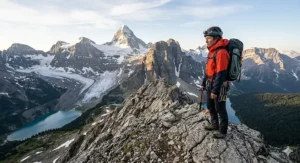
A 3 layer rain jacket for mountaineering isn’t just a layer. In Canada’s alpine environment, it’s load-bearing safety equipment. Canadian climbers face conditions that are genuinely different from what marketing brochures depict: sustained multi-day storms in the Coast Mountains of BC, sudden whiteouts above the treeline in Banff, and the kind of wet-cold combination that makes the Rockies notorious even among seasoned alpinists. A jacket that performed brilliantly in a product photo won’t necessarily keep you dry when you’re melting snow for water at 3,000 metres (9,800 ft) in mid-October.
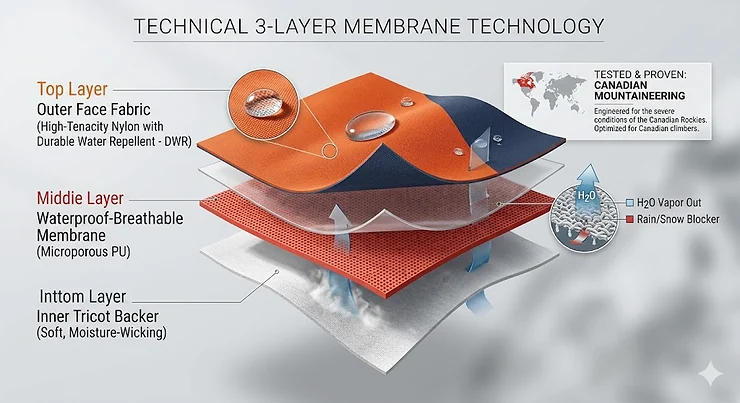
What separates a true technical mountaineering shell from a stylish hardshell is a short but decisive list: a genuine 3-layer construction that bonds face fabric, membrane, and backer into one unified system; a helmet-compatible hood that stays put when the wind is trying to rip it off; harness-compatible pockets that aren’t blocked the moment you rack your gear; and a membrane rated to withstand the kind of sustained precipitation that Canadian mountains specialize in. The best options also weigh under 450 grams (16 oz), compress into a fist-sized package, and breathe well enough that you’re not swimming in your own perspiration on a steep approach.
This guide reviews seven of the best 3 layer rain jacket for mountaineering options available on Amazon.ca in 2026, from expedition-grade armour to capable mid-range shells that won’t require a second mortgage. All prices are in Canadian dollars (CAD). Let’s get into it.
Quick Comparison: Top 7 Mountaineering Shell Jackets for Canada (2026)
| Jacket | Membrane | Weight (approx.) | Helmet Hood | Harness Pockets | Best For | Price Range (CAD) |
|---|---|---|---|---|---|---|
| Arc’teryx Alpha SV | GORE-TEX Pro ePE 100D | ~490g | ✅ StormHood | ✅ | Expedition/severe alpine | $1,200–$1,450 |
| Arc’teryx Beta AR | GORE-TEX Pro ePE 80D | ~390g | ✅ | ✅ | All-around 4-season | $900–$1,050 |
| Patagonia Triolet Alpine | GORE-TEX ePE 75D | ~560g | ✅ | ✅ | Budget alpine / ski touring | $500–$650 |
| Black Diamond StormLine Stretch | BD.dry 3L 4-way stretch | ~335g | ✅ | ✅ | Fast-and-light climbing | $300–$400 |
| Outdoor Research Helium UL | Toray Dermizax 20K/20K | ~175g | ✅ | Limited | Ultralight/packable | $350–$450 |
| Himali Monsoon Hardshell | Toray Dermizax 20K/20K | ~400g | ✅ | ✅ | Value-premium option | $500–$650 |
| Mountain Hardwear Ozonic | Dry.Q Active 3L | ~310g | ✅ | ✅ | Versatile 3-season use | $350–$480 |
Prices are approximate ranges in CAD and may vary. Always check current pricing on Amazon.ca.
The table above tells a useful story: you’re really choosing between two priorities — durability-first (Alpha SV, Triolet) or weight-first (Helium UL, StormLine). For multi-day Canadian alpine objectives where you need the jacket to take crampon snags, rope drag, and days of sustained rain, heavier 100D fabrics earn their weight penalty. For single-day fast routes or as emergency insurance for a capable trail runner, sub-300g options are entirely valid. Your choice of objective — not your budget — should drive the decision.
💬 Just one click — help others make better buying decisions too! 😊
✨ Don’t Miss These Exclusive Deals!
🔍 Take your mountaineering game to the next level with these carefully selected shells. Click on any highlighted product below to check current pricing and availability on Amazon.ca. The right jacket can turn a grim day on a Canadian peak into an adventure worth repeating.
Top 7 Best 3 Layer Rain Jacket for Mountaineering: Expert Analysis
1. Arc’teryx Alpha SV Jacket— The Expedition Standard
If you’ve ever looked at a hardshell and thought “I want it to be indestructible,” this is the jacket you were imagining. The Alpha SV is built on 100D GORE-TEX PRO ePE — a PFAS-free membrane bonded to the brand’s most abrasion-resistant face fabric. In practice, that 100-denier construction means the jacket shrugs off crampon snags, pack abrasion, and endless rope contact that would leave a thinner shell looking tatty within a season.
The feature set reads like a mountaineering checklist. The helmet-compatible StormHood adjusts in two dimensions so it moves with your head rather than against it, and it stays on your dome in gale-force gusts — a non-negotiable for exposed ridgelines in the Canadian Rockies. Pockets are cut high and wide enough to remain fully accessible while wearing a climbing harness, and the 2026 update added internal dump pockets for gloves and a toque. A low-profile RECCO® reflector is embedded in the hood, which matters when you’re operating in remote terrain where search and rescue response times in Canada can be several hours.
This is unequivocally the jacket for serious Canadian alpinists — those doing committing ascents on Robson, routes in the Bugaboos, or extended Rockies objectives where the weather window can slam shut without warning. It is not a jacket for casual hikers, and the price in the $1,200–$1,450 CAD range reflects that honestly. Think of it as a cost-per-use investment: this shell will outlast three cheaper alternatives.
Customer feedback consistently praises the Alpha SV’s weather exclusion as virtually absolute, with experienced Canadian mountaineers noting it performs as well in its fifth season as its first.
✅ Virtually indestructible face fabric for sustained alpine use
✅ Helmet-compatible StormHood with RECCO reflector
✅ Harness-accessible pocket layout
❌ Premium price point ($1,200–$1,450 CAD) — significant investment
❌ One-way main zipper limits ventilation options on aggressive ascents
2. Arc’teryx Beta AR Jacket — The Versatile All-Rounder
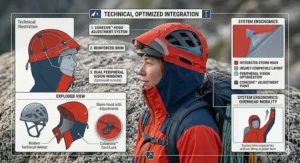
“AR” stands for All-Round, and that name understates the jacket’s usefulness. While the Alpha SV is purpose-built for severe alpine, the Beta AR does everything from summit days to bad-weather backcountry skiing to damp October scrambles in the Laurentians. The 80D GORE-TEX Pro ePE face fabric sits just below the Alpha’s burly 100D but still offers well above average abrasion resistance for technical terrain.
At approximately 390 grams, the Beta AR is noticeably lighter than the Triolet or Alpha SV, yet it retains a fully technical feature set: helmet-compatible hood, harness-compatible pockets, pit zips for ventilation, and a C-Knit backer that feels genuinely comfortable against midlayer fleeces on multi-day trips. The trim alpine fit is cut with enough room for active insulation underneath — critically important for Canadian shoulder seasons where you’ll be layering more aggressively than the California test conditions most brands use.
The Beta AR is the jacket we’d recommend to the Canadian climber who does a mix of alpine routes, ski touring, and year-round backcountry travel. It’s genuinely excellent at all of them. At $900–$1,050 CAD on Amazon.ca, it’s not cheap, but it bridges the gap between recreational hardshell and full expedition armour more convincingly than anything else in this list.
Customer reviews from Canadian buyers highlight exceptional longevity and consistent weather protection across every Canadian climate zone from wet coastal BC to the drier but savage cold of Alberta winters.
✅ Versatile enough for climbing, skiing, and backcountry use year-round
✅ C-Knit backer is noticeably more comfortable against midlayers
✅ Lighter than the Alpha SV without sacrificing key mountaineering features
❌ Slightly shorter back hem than ideal for multi-day pack hauling
❌ Pit zips could be larger for aggressive aerobic efforts
3. Patagonia Triolet Alpine Jacket — The Workhorse Budget Pick
Patagonia builds the Triolet with a straightforward philosophy: prioritise protection and durability, keep the price as honest as possible. The result is a 3-layer GORE-TEX ePE Performance shell built on a recycled 75-denier face fabric that is legitimately tough — closer to the Alpha SV’s durability profile than any other jacket at this price point. If you’re doing the kind of mountaineering where you expect your shell to take a beating and you can’t justify $1,200 CAD, the Triolet deserves serious attention.
The jacket is notably heavy at around 560 grams (nearly 20 oz), and that’s a real consideration for committed alpinists. The thick 75D face fabric that makes it so durable is the same reason it doesn’t fold into a stuff pocket. For ski tourers, winter mountaineers, and mixed climbers in Canada’s wetter ranges — the Selkirks, the Coast Mountains, the Cariboos — the weight penalty is worth the added durability and protection. The harness-compatible hand pockets are generously sized, the hood accommodates a helmet comfortably, and Patagonia’s legendary repair programme means this jacket is a long-term relationship rather than a single-season purchase.
One genuine limitation: the main zipper is one-way only, which means no lower zipper opening for easy harness access on cold belays. For routes where you’re spending extended time standing still and clipping gear, this is genuinely inconvenient. That said, at $500–$650 CAD range, it’s the best value-for-protection proposition in technical alpine shells on Amazon.ca.
Canadian reviewers from BC’s mountain parks specifically praise its performance in sustained coastal rain — the kind of multi-day soaking that exposes any weakness in a shell’s seam sealing and DWR treatment.
✅ Outstanding durability for the price — 75D face fabric is nearly bulletproof
✅ Full GORE-TEX ePE protection in sustained rain and wind
✅ Patagonia’s repair policy adds genuine long-term value in CAD
❌ Heavy at ~560g — not a fast-and-light option
❌ One-way main zipper is inconvenient for technical climbing
4. Black Diamond StormLine Stretch Rain Shell — The Climber’s Choice for Movement
The spec sheet won’t tell you this, but when you’re stemming a wet crack in the Canadian Rockies and your jacket is fighting you for arm extension, you quickly develop very strong opinions about stretch fabric. Black Diamond’s StormLine Stretch is built on BD.dry 3-layer construction with 4-way stretch nylon — and the difference in freedom of movement on technical terrain is immediately apparent.
The BD.dry membrane is not GORE-TEX, and in long-duration sustained heavy rain the StormLine will eventually absorb more moisture than the Alpha SV or Beta AR. What it does extraordinarily well is breathe during aerobic climbing efforts, shed moderate precipitation without complaint, and stay completely out of your way when you’re moving. The helmet-compatible hood tucks away cleanly, the pockets work with a harness, and the whole package weighs around 335 grams. At $300–$400 CAD, it’s the most accessible technical shell in this list.
For Canadians doing single-day rock and alpine routes in summer, or climbing crags in the shoulder seasons, this is the practical pick. It’s also ideal as a second shell in a multi-layer system — worn over insulation when the weather is severe, packed away when conditions allow. Less suited for true expedition use or multi-day Canadian alpine objectives where sustained protection trumps packability and stretch.
Buyers consistently praise its range of motion, noting it’s among the few technical shells that doesn’t feel like a straight jacket during dynamic climbing moves.
✅ 4-way stretch fabric offers unmatched freedom of movement for technical climbing
✅ Lightweight (~335g) and packable for fast-and-light objectives
✅ Accessible price range for Canadian climbers ($300–$400 CAD)
❌ BD.dry membrane less robust than GORE-TEX Pro in sustained multi-day precipitation
❌ Limited internal pocket options compared to expedition-grade shells
5. Outdoor Research Helium UL Jacket — The Featherweight Emergency Shell
Toray Dermizax — a Japanese membrane technology — sounds obscure until you understand what it achieves: a 20,000mm waterproof / 20,000 g/m²/24hr breathability rating in a construction that weighs just 175 grams. The Helium UL is the jacket you carry “just in case” on every objective, because at that weight you genuinely forget it’s in your pack until you need it.
The 2026 Helium UL uses Toray Dermizax in a construction that Outdoor Research describes as 2.75-layer — closer to true 3-layer than a traditional 2.5L, with a 3D interior backer that provides more protection than a simple coating. In field use during sustained precipitation, Canadian testers have found it performs more like a proper 3L than its construction suggests. The hood fits over a climbing helmet, the seams are fully taped, and there’s a chest pocket for essentials.
What it lacks are harness-compatible handwarmer pockets (there are none), pit zips, and the kind of durable face fabric that survives rope and rock contact. This is a shelter jacket — brilliant for summit emergencies, ski tours where you’ll wear it briefly, or as the outer layer in a very refined ultralight system. At $350–$450 CAD on Amazon.ca, it’s remarkable value for the protection-to-weight ratio. Shipping to remote Canadian communities may take longer — worth factoring in for northern and rural buyers.
Ultralight-focused Canadian buyers praise it as the most packable genuinely waterproof shell available, describing it as “the jacket you’ll forget is in your bag until it saves your trip.”
✅ Exceptional weight (~175g) — genuinely disappears in a pack
✅ 20K/20K Toray Dermizax rating handles moderate alpine conditions well
✅ Fully taped seams and helmet-compatible hood in an ultralight package
❌ No harness-compatible handwarmer pockets — limits technical climbing utility
❌ Face fabric not durable enough for sustained pack/rope abrasion
6. Himali Monsoon Hardshell Jacket — The Hidden Gem Worth Knowing About
Himali is a Colorado-based brand founded by an 18-time Everest summiter, and their approach to jacket design reflects that biography. The Monsoon Hardshell uses the same Toray Dermizax 20K/20K 3-layer construction as the Outdoor Research Helium UL, but in a full-featured technical shell with harness-compatible pockets, helmet-compatible hood, and pit zips. The fabric is notably supple and quiet — closer to the feel of an older C-Knit backer than the stiffer GORE-TEX Pro options.
In Canadian Rockies and Coast Mountain testing, the Monsoon has proven genuinely impressive in heavy rain and dense coastal mist. The brand isn’t as broadly available on Amazon.ca as Arc’teryx or Patagonia, so check availability carefully — shipping times to more remote Canadian communities (northern Ontario, the Prairies, northern BC) may exceed the standard 2-3 business days. When available, price ranges around $500–$650 CAD represent exceptional value for the technical specification.
This is the jacket for the informed Canadian climber who’s done enough research to look past the big brand names and recognizes that Dermizax performs comparably to GORE-TEX in most real-world Canadian conditions. It’s the “best-kept-secret” pick in this list — and worth adding to your shortlist before defaulting to the premium Arc’teryx options.
Canadian Rocky Mountain and Vancouver Island testers specifically praised its soft hand feel and quiet fabric in cold temperatures, noting it doesn’t stiffen the way some GORE-TEX Pro options do in sub-zero conditions.
✅ Toray Dermizax 20K/20K — genuine expedition-grade protection in a softer package
✅ Full technical feature set: harness pockets, helmet hood, pit zips
✅ Founded and designed with high-altitude expertise — not a marketing product
❌ Availability on Amazon.ca can be inconsistent — check shipping to your province
❌ Less established Canadian brand support/warranty service infrastructure than Arc’teryx
7. Mountain Hardwear Ozonic Jacket — The Comfortable All-Conditions Shell
Mountain Hardwear’s Dry.Q Active membrane has always prioritized breathability over sheer waterproofing muscle, and the Ozonic is the clearest expression of that philosophy. At around 310 grams in a 3-layer construction, it sits in the lightweight end of the technical shell spectrum while offering a notably more comfortable fit than the trimmer alpine cuts of Arc’teryx or Himali. That slightly roomier silhouette is actually an advantage for Canadian buyers who layer more aggressively in cold conditions — there’s room for a mid-layer fleece without the jacket turning into a straitjacket.
The helmet-compatible hood, pit zips, and accessible pockets cover the technical basics. The Ozonic also earned strong marks for breathability on aerobic ascents — the Dry.Q Active membrane performs particularly well when you’re generating significant heat on a long approach, reducing the clammy interior moisture buildup that plagues some GORE-TEX options. It’s available on Amazon.ca in the $350–$480 CAD range, making it one of the stronger mid-tier values in this list.
Where it earns a slight caveat is in truly sustained, extreme precipitation over multi-day periods. In those conditions, Dry.Q Active doesn’t quite match the moisture exclusion of GORE-TEX Pro. For Canadian 3-season use and milder winter objectives, that limitation rarely surfaces. For extended shoulder-season expeditions in BC’s notoriously wet coastal ranges, step up to GORE-TEX Pro.
Canadian buyers in wetter climates note it’s best described as an excellent 3-season shell that earns its place in a quiver alongside a burlier winter option.
✅ Exceptional breathability for aerobic climbing efforts
✅ Comfortable, slightly roomier fit accommodates generous layering
✅ Good value for performance at $350–$480 CAD
❌ Dry.Q Active less suited to sustained multi-day precipitation than GORE-TEX Pro
❌ Somewhat looser fit is less ideal for technical climbing movements
How to Choose a 3 Layer Rain Jacket for Mountaineering in Canada: A Buyer’s Decision Framework
The Canadian alpine environment presents a specific set of demands that you won’t encounter in more forgiving mountain ranges. Before you scroll back up and click “Buy,” here’s how to match your needs to the right shell.
If you’re doing serious multi-day alpine routes in the Coast Mountains, Selkirks, or Rockies, choose a jacket with a GORE-TEX Pro membrane and at least a 70D face fabric. The Alpha SV or Beta AR belong in this category. Canada’s wetter mountain ranges are genuinely unforgiving on gear, and the durability premium paid upfront is far cheaper than replacing a $350 jacket every season.
If you’re primarily a ski tourer or mixed-terrain mountaineer doing single-day objectives, the Patagonia Triolet or Himali Monsoon give you excellent protection without the full expedition price tag. Both handle ski resort conditions, backcountry touring, and moderate alpine equally well.
If weight is your primary constraint — you’re pursuing fast-and-light alpine style or you’re a trail runner who needs emergency weather protection — the Outdoor Research Helium UL or Black Diamond StormLine Stretch offer the best weight-to-protection ratios. Just be honest that they are storm-insurance tools, not siege-climbing armour.
For the Canadian budget buyer who wants reliable protection without a four-figure outlay: the Black Diamond StormLine Stretch at $300–$400 CAD delivers genuine technical performance at an accessible price. Pair it with a good mid-layer and base layer system, and it handles the vast majority of Canadian alpine conditions you’ll actually encounter in a typical climbing season.
If you’re buying for shoulder-season use in eastern Canada — think the Chic-Chocs in Quebec, the Maritimes coast, or Ontario’s Lake Superior region — the Mountain Hardwear Ozonic is a smart choice. The breathability advantage matters in the wet, cool conditions typical of eastern Canadian peaks.
Real Canadian Climbers, Real Canadian Conditions: Case Studies
Profile 1 — The Weekend Alpinist in the Rockies (Calgary-based, moderate budget) Meet someone like Jordan: an experienced hiker transitioning into technical alpinism, doing weekend objectives in Kananaskis and Banff National Parks during the May–October window. Their budget is around $600–$700 CAD for outerwear. The Patagonia Triolet makes the most sense here — it’s tough enough for technical terrain, the GORE-TEX ePE protection handles Rockies summer storms, and at $500–$650 CAD there’s budget left for boots and a belay device. The heavier weight (560g) isn’t an issue for day objectives with a moderate pack weight.
Profile 2 — The BC Coast Mountain Expedition Climber (Vancouver-based, premium budget) Someone like Priya: a semi-professional alpinist doing week-long objectives in the Waddington Range or winter routes on Mount Garibaldi. For extended exposure to BC’s legendary horizontal rain and zero visibility, the Arc’teryx Alpha SV is not optional — it’s the minimum adequate tool. The 100D face fabric needs to survive multiple days of sustained pack contact, wet rock, and crampon snag risk. At $1,200–$1,450 CAD it’s a serious investment, but so is helicopter rescue if your shell fails on day three of a remote BC objective.
Profile 3 — The Fast-and-Light Alpinist (Montréal-based, ultralight priority) Think Alex: a competitive mountain runner transitioning into technical alpinism, primarily doing single-day objectives in the Laurentians and Chic-Chocs. Weight is everything. The Outdoor Research Helium UL at 175 grams is a no-brainer — pack it on every run as emergency protection, add it over insulation when conditions deteriorate, forget it when the sky is blue. At $350–$450 CAD it’s a reasonable expenditure for peace of mind on objectives where you genuinely can’t afford shelter.
Features That Actually Matter in a Canadian Mountaineering Shell (And Marketing Fluff to Ignore)
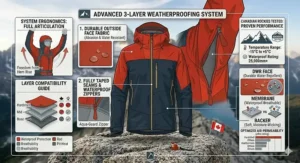
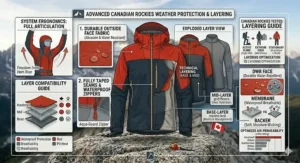
Membrane rating (waterproof/breathability): MATTERS, with nuance. A 28,000mm waterproof rating is more than adequate for any Canadian alpine condition. Marketing materials love quoting impressive numbers, but the difference between 20,000mm and 28,000mm in practical use is negligible — what matters is how well the DWR is maintained and how thoroughly the seams are taped. Full seam sealing is non-negotiable for Canadian conditions; partial seam sealing is only acceptable on the lightest emergency shells.
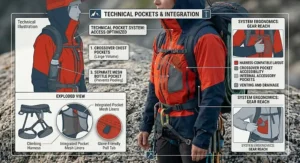
Hood geometry: MATTERS enormously. A helmet-compatible hood that stays in place in wind is not a luxury feature for Canadian mountaineering — it is a safety feature. Parks Canada’s Mountain Safety resources consistently emphasize helmet use for any technical terrain, and your shell hood needs to accommodate that helmet without blocking peripheral vision or requiring both hands to adjust.
Pocket placement: MATTERS for technical use. Harness-compatible pockets placed above the hip belt line are only relevant if you’re on a rope. For pure hiking use, ignore this spec. For any roped climbing — sport, trad, alpine — it’s critical. Having your primary pockets accessible while tied in saves fumbling time on exposed terrain.
Pit zips: NICE TO HAVE, not essential. They improve ventilation significantly on aerobic ascents, but every jacket in this list with pit zips weighs more because of the additional hardware and reinforcement. If you run hot on approaches, prioritize pit zips. If you run cold, they’re extra weight.
PFAS-free DWR: INCREASINGLY MATTERS. Multiple jackets in this list — including the Arc’teryx Alpha SV, Patagonia Triolet, and Black Diamond StormLine — now use DWR finishes without intentionally added PFAS (per- and polyfluoroalkyl substances). This matters both environmentally and from a Health Canada regulatory perspective, as PFAS compounds are increasingly regulated in Canadian consumer products. PFAS-free DWR performs comparably in most conditions when properly maintained.
3-layer vs 2.5-layer construction: MATTERS for mountaineering specifically. The third layer — a knit backer laminated directly to the membrane — eliminates the floppy inner lining that soaks up sweat and adds weight. For a hiking jacket used occasionally in the rain, 2.5L is fine. For a jacket that needs to layer cleanly over technical midlayers during a multi-pitch alpine climb, 3L is worth the price premium.
Hardshell vs Softshell for Canadian Mountaineering: Which Actually Wins?
This comparison comes up constantly, and the honest answer is both — but not interchangeably. A hardshell like the jackets in this review is 100% waterproof and windproof; a softshell is highly breathable and stretch-friendly but only water-resistant at best. Understanding which Canadian conditions favour which type saves you from bringing the wrong tool.
Choose a 3 layer hardshell when: the forecast includes sustained precipitation, you’re on a route with wind exposure above treeline, you’re doing any type of glacier travel where crevasse rescue protocol requires extended stationary time in cold and wet, or you’re tackling multi-day objectives in BC’s coastal mountains where a “partly cloudy” forecast can become a 36-hour deluge.
Consider a softshell instead when: the conditions are cold and dry with high exertion (ski touring in clear-weather Banff, for example), you’re prioritizing breathability over rain protection, or you’re at low altitude with bailout options. Brands like Rab and Black Diamond make exceptional softshells for these conditions.
For most serious Canadian alpinists, the honest recommendation is to own both: a mid-range hardshell for mixed-weather use and a premium technical shell for the objectives that actually require expedition-grade protection. The cost of owning two purpose-built tools is almost always less than the cost of one jacket that tries to compromise between both.
✨ Ready to Gear Up?
🔍 Every jacket reviewed here is worth your time to investigate. Check current pricing and availability on Amazon.ca by clicking any highlighted product. Equip yourself for the Canadian mountains with shells tested under conditions that actually match where you’re headed.
Canadian Regulations, Safety Standards & What They Mean for Your Gear Choices
Mountaineering in Canada’s national and provincial parks comes with specific responsibility frameworks worth understanding before you head into technical terrain. Parks Canada’s Mountain Safety programme covers the Mountain National Parks including Banff, Yoho, Kootenay, Jasper, Glacier, and Waterton Lakes — together representing the core of Canada’s alpine climbing geography.
Parks Canada doesn’t mandate specific gear brands or shell specifications, but their safety guidelines strongly emphasize self-sufficiency and appropriate equipment for conditions. An experienced Canadian mountain guide operating under the Association of Canadian Mountain Guides (ACMG) certification will typically include a waterproof hardshell on their mandatory gear list for any technical objective — not as a suggestion, but as a non-negotiable prerequisite for rope service.
For backcountry objectives in Glacier and Banff National Parks — which together represent over 1,000 routes ranging from glacier walks to Grade VI alpine test pieces — a GORE-TEX Pro or equivalent 3-layer shell is standard issue among qualified guides. The conditions that make the Canadian Rockies notorious (“if you can climb in the Canadian Rockies, you can climb anywhere” is a phrase heard in every mountaineering course) demand gear that genuinely meets its rated specifications under sustained use.
From a consumer products perspective: all technical outdoor apparel sold in Canada must meet bilingual labelling requirements under the Consumer Packaging and Labelling Act, and care instructions must appear in both English and French. This is relevant if you’re purchasing directly from US retailers versus Amazon.ca — domestically sold products will carry bilingual labels as legally required.
Long-Term Cost & Maintenance in Canada: The Real Price of Your Shell
Here’s a calculation most buyers skip: a $1,350 CAD Arc’teryx Alpha SV, properly maintained, will serve a serious Canadian alpinist for 8–12 years. A $350 CAD recreational shell, degrading faster under technical use, might need replacement every 2–3 seasons. Over a decade, the math often favours the premium option — especially factoring in the Arc’teryx repair programme, which will reseal seams, replace zippers, and restore DWR treatment for a fraction of replacement cost.
DWR maintenance is the single highest-ROI maintenance task for any technical shell in Canada’s wet mountain climates. When your jacket starts “wetting out” — absorbing moisture into the face fabric and feeling heavy and clammy despite remaining technically waterproof — the membrane is usually fine; the DWR coating has degraded. A $20 CAD bottle of Nikwax TX.Direct wash-in treatment restores DWR performance in a single application. Do this once per season, or whenever you notice wetting out — never wait until the jacket feels saturated.
For GORE-TEX membranes specifically: tumble-drying on low heat actually reactivates DWR treatment. This isn’t common knowledge, but it’s published guidance from W.L. Gore — a 20-minute low-heat tumble dry after washing is genuinely part of the recommended care protocol for Canadian climbers who wash their shells frequently.
Storage matters more in Canada than in warmer climates. Storing your shell compressed in a stuff sack long-term degrades both the membrane lamination and the DWR coating. Hang storage is strongly preferred. In Canadian summer/winter cycling, the rapid humidity and temperature changes of BC garages and Ontario basements are particularly harsh on stored shells — dry, climate-controlled storage extends jacket life measurably.
FAQ: Best 3 Layer Rain Jacket for Mountaineering in Canada
❓ What is the difference between 2-layer, 2.5-layer, and 3-layer rain jackets for mountaineering?
❓ Are 3 layer rain jackets for mountaineering available on Amazon.ca with free shipping to Canada?
❓ What waterproof rating do I need for technical mountaineering in the Canadian Rockies?
❓ Can I use my mountaineering shell as a ski jacket in Canada?
❓ How do I maintain a GORE-TEX mountaineering jacket in Canadian winter conditions?
Conclusion: The Right 3 Layer Rain Jacket for Mountaineering Changes Everything
Canada’s mountains — from the glaciated peaks of the Coast Range to the dramatic walls of the Rockies and the rugged backcountry of Québec’s Chic-Chocs — are genuinely extraordinary places to climb. They’re also genuinely demanding environments where the gap between well-equipped and underprepared can close faster than a summer storm. Choosing the right 3 layer rain jacket for mountaineering isn’t about brand loyalty or following trends; it’s about matching your objective to a tool that will perform when performance actually matters.
For serious Canadian alpinists: the Arc’teryx Alpha SV or Beta AR represent the standard against which everything else is measured, and their longevity justifies the CAD investment. For climbers building their first technical kit on a real-world budget, the Patagonia Triolet and Black Diamond StormLine Stretch offer honest, capable protection at more accessible price points. The Himali Monsoon is the informed buyer’s premium-value pick. And the Outdoor Research Helium UL belongs in every technical pack as weight-nothing storm insurance.
Whatever you choose, maintain it properly, understand its limitations before you commit to an objective, and check Parks Canada’s mountain safety resources before venturing into serious terrain. The best jacket is the one that keeps you dry, moving, and capable of making good decisions on the mountain — and getting back down safely. That’s what this whole exercise is about.
✨ Don’t forget — great gear makes great days in the mountains. Click any highlighted product to check current pricing and availability on Amazon.ca. Your next Canadian alpine adventure starts here!
Recommended for You
- 3 Layer vs 2.5 Layer Rain Jacket: 7 Best Picks for Canada 2026
- 7 Best 3 Layer Hardshell Jackets Canada 2026
- Best 7 Packable Rain Jackets for Backpacking in Canada 2026
Disclaimer: This article contains affiliate links. As an Amazon Associate, I earn from qualifying purchases. If you purchase products through these links, we may earn a small commission at no additional cost to you. All prices listed are approximate ranges in Canadian dollars (CAD) and are accurate at the time of research — always confirm current pricing on Amazon.ca.
✨ Found this helpful? Share it with your climbing partners! 💬🤗
