
In This Article
Rain doesn’t care what’s in your bank account. It’ll find the gap in a C$40 jacket just as gleefully as it slides off a C$600 one — the question is how long that gap takes to open up, and whether you notice before your commute is ruined. That’s really what the cheap vs expensive rain jacket worth it debate comes down to: not “which one keeps you dry,” because most decent jackets will, at least for a while, but “which one keeps you dry reliably, season after season, without turning into a sweaty plastic bag halfway through your walk.” Vancouver alone sees rain more days than not through the fall and winter, and if you live anywhere from the Maritimes to the West Coast, your jacket isn’t a seasonal accessory — it’s infrastructure. This guide breaks down seven real jackets spanning ultra-budget to genuinely premium, tested against specs, verified review sentiment, and honest cost-per-wear math, so you can figure out where your own money is actually well spent.
Quick Comparison Table
| Product | Price Range (CAD) | Waterproof Rating | Best For |
|---|---|---|---|
| Frogg Toggs Ultra-Lite2 | C$35-50 | ~5,000mm | Emergency backup, infrequent use |
| Columbia Watertight II | C$75-100 | ~8,000mm | Casual weekend wear on a budget |
| Marmot PreCip Eco | C$140-170 | ~10,000mm | Frequent hikers who still want value |
| The North Face Venture 2 | C$170-200 | ~10,000mm | Daily commuters, all-around use |
| Rab Downpour Plus 2.0 | C$220-260 | ~10,000-20,000mm | Step-up buyers who hate crinkly fabric |
| Patagonia Torrentshell 3L | C$250-290 | 3-layer H2No | Serious hikers wanting 3-layer performance |
| Arc’teryx Beta SL | C$600-680 | Gore-Tex ePE | Year-round wet-climate use, alpine trips |
A quick scan of this table already tells the real story: the jump from Frogg Toggs Ultra-Lite2 to Columbia Watertight II roughly doubles the price but buys real durability, while the leap from Rab Downpour Plus 2.0 to Arc’teryx Beta SL is almost triple the cost for a membrane upgrade most casual users will never fully exploit. Waterproof rating numbers matter, but as you’ll see further down, they’re only half of what determines whether a jacket earns its price tag.
💬 Just one click — help others make better buying decisions too!😊
Top 7 Rain Jackets: Expert Analysis
1. Frogg Toggs Ultra-Lite2 Rain Jacket — cheapest jacket that actually works
The Frogg Toggs Ultra-Lite2 is the jacket you buy when you need something in the C$35-50 range that won’t leave you drenched on a surprise downpour, and honestly, it does that job better than its price suggests. Built from a non-woven, breathable polypropylene shell rated around 5,000mm hydrostatic head, it blocks light-to-moderate rain effectively, though it’s not designed for sustained downpours or high-abrasion use — this is a jacket for the glovebox or the daypack, not the daily commute. Based on the spec comparison, this makes the most sense for hikers, festival-goers, or anyone who needs backup protection a few times a year rather than a primary shell; anyone expecting alpine-grade durability from a jacket this light will be disappointed, and that’s simply physics, not a flaw. Aggregated reviewer sentiment consistently praises the astonishing weight-to-price ratio and packability, while a recurring complaint is that the fabric tears easily on branches or rough surfaces and the fit runs boxy. What most buyers overlook is that this jacket essentially trades fabric density for cost — you’re paying for waterproofing, not longevity.
Pros:
- ✅ Lowest price point of any jacket on this list
- ✅ Packs down smaller than a water bottle
- ✅ Genuinely breathable for its price class
Cons:
- ❌ Fabric tears easily against branches or rough surfaces
- ❌ Not built for regular, heavy-duty use
At around C$35-50, the Frogg Toggs Ultra-Lite2 is hard to argue with as an emergency layer, but it’s the wrong choice if you’re asking whether an expensive rain jacket is worth it for daily wear — it simply isn’t designed for that job.
2. Columbia Watertight II Jacket — best budget all-rounder
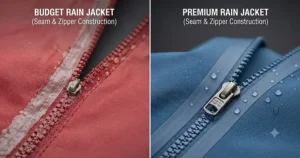
Sitting a notch above true emergency shells, the Columbia Watertight II is where a budget rain jacket vs premium comparison starts to feel more like a fair fight. Its Omni-Tech 2-layer waterproof-breathable membrane is rated to roughly 8,000mm, enough to shrug off a genuinely wet afternoon rather than just a passing shower, and the mesh-lined interior keeps it from feeling like a garbage bag against your skin. Here’s what to weigh: this jacket is built for casual, everyday scenarios — dog walks, school runs, errands in the rain — rather than backcountry punishment, and the adjustable hood and cuffs are basic but functional rather than refined. Reviewers consistently note that it holds up well through several rainy seasons of normal use, though a common complaint is that the coated lining can feel a bit stiff and starts to peel at the seams after a few years of heavy washing. The zippers aren’t storm-sealed, relying instead on a front placket, which keeps costs down but does let in a bit of moisture in wind-driven rain.
Pros:
- ✅ Genuinely wearable 2-layer waterproof membrane
- ✅ Comfortable mesh lining, not clammy for short wear
- ✅ Wide range of sizes and colours typically in stock
Cons:
- ❌ Seam coating can peel after a few years
- ❌ Non-sealed zipper lets in some wind-driven rain
At roughly C$75-100, the Columbia Watertight II delivers real, dependable performance for casual use, and it’s arguably the best entry point if you’re not ready to spend premium money yet.
3. Marmot PreCip Eco Jacket — most trusted budget name in the game
The Marmot PreCip Eco has quietly become the jacket outdoor reviewers reach for when they need a budget benchmark, and for good reason: its NanoPro waterproof-breathable membrane hits roughly 10,000mm hydrostatic head, matching jackets that cost twice as much, while the recycled fabric keeps the environmental footprint lower. Pit zips, adjustable cuffs, and a hood that rolls away into the collar are small touches that punch well above the price class — on paper this means you’re getting features usually reserved for mid-range shells at a genuine budget price. Based on the spec comparison, this is the pick for hikers and commuters who want one jacket that handles both trail and city without feeling like a compromise in either direction. Aggregated review sentiment is strongly positive on stretch and comfort, with a recurring theme that the jacket can feel clammy in warm, humid rain and the interior coating shows early signs of delamination after prolonged heavy use.
Pros:
- ✅ 10,000mm rating rivals pricier mid-range shells
- ✅ Pit zips and stowable hood add real functionality
- ✅ Recycled fabric construction, better sustainability profile
Cons:
- ❌ Can feel clammy in warm, humid rainfall
- ❌ Interior coating shows early delamination with heavy use
Priced around C$140-170, the Marmot PreCip Eco is arguably the sharpest value pick on this entire list — it’s the jacket that makes the “is expensive rain gear worth it” question genuinely hard to answer.
4. The North Face Venture 2 Jacket — reliable everyday commuter shell
The North Face Venture 2 occupies the same crowded mid-budget space as the PreCip Eco, but takes a slightly different approach: its DryVent 2.5-layer shell trades a bit of interior comfort for a lighter, more packable build that’s easier to stuff in a work bag. What most buyers overlook about this model is that the 2.5-layer construction (a printed interior coating rather than a full mesh liner) keeps the weight down but means the jacket can feel a touch plasticky against bare skin during long wear. Reviewers consistently report that it’s dependable for city use — commuting, dog walks, errands — but starts wetting out faster than 3-layer alternatives during extended exposure, which lines up with what you’d expect from the spec sheet. The adjustable hood, drawcord hem, and secure-zip pockets are genuinely useful daily-life features, and the jacket layers well over a fleece for cooler, wetter days. Honest analytical take: this is the shell for someone who wants “good enough, every day” rather than “excellent, occasionally.”
Pros:
- ✅ Lightweight and highly packable for daily carry
- ✅ Adjustable hood, hem, and secure zip pockets
- ✅ Layers comfortably over a fleece or hoodie
Cons:
- ❌ 2.5-layer build wets out faster in sustained rain
- ❌ Interior coating feels plasticky against bare skin
At around C$170-200, the North Face Venture 2 is a dependable everyday jacket, though the price range comparison here shows you’re paying partly for the brand recognition, not just the fabric tech.
5. Rab Downpour Plus 2.0 Jacket — best step-up value pick
If you’ve outgrown budget shells but aren’t ready to spend Arc’teryx money, the Rab Downpour Plus 2.0 is the jacket that quietly outperforms its price bracket. Its Pertex Shield fabric avoids the crinkly, cheap-tarp feel that plagues so many budget-to-mid shells, and the hydrostatic head sits comfortably in the 10,000-20,000mm range depending on the exact build year, which is a meaningful step up in sustained-rain performance. Here’s what to weigh: the stiff-brimmed hood, underarm vents, and adjustable hem give it genuine hiking credibility, while the more tailored cut also makes it flattering enough for daily wear — a combination budget jackets rarely manage. Reviewers consistently describe it as noticeably more comfortable to the touch than cheaper alternatives and reliable across multiple wet seasons, with the main knock being that it runs slightly heavier than ultralight competitors and the price sits awkwardly between “budget” and “premium” categories. What the spec sheet won’t tell you, but reviewers note, is that the fit flatters a wider range of body types than most technical shells.
Pros:
- ✅ Fabric avoids the stiff, crinkly feel of cheaper shells
- ✅ Stiff brim hood and underarm vents aid real hiking use
- ✅ Flattering, versatile fit for trail and street wear
Cons:
- ❌ Heavier than ultralight competitors in its price range
- ❌ Sits in an awkward price gap between budget and premium
At roughly C$220-260, the Rab Downpour Plus 2.0 is the jacket for buyers doing genuine value-for-money math — it delivers most of the comfort of premium shells without the premium price tag.
6. Patagonia Torrentshell 3L — 3-layer performance without alpine pricing
The Patagonia Torrentshell 3L has become something of a benchmark in rain jacket price comparison discussions because it delivers full 3-layer H2No waterproof-breathable protection — construction typically reserved for jackets costing significantly more — at a price that’s still accessible to serious but non-professional users. Based on the spec comparison, that third layer (a moisture-wicking interior laminate rather than a loose mesh liner) is the real differentiator: it breathes noticeably better during high-output activity than the 2 and 2.5-layer jackets earlier on this list, so you’re less likely to end up sweat-soaked from the inside even while staying dry from the outside. It’s also fully PFC-free, which matters increasingly given Canada’s tightening PFAS regulations (more on that later). Reviewers consistently rate the breathability and non-clammy interior highly, with the most common critique being that the face fabric has a noticeably crinkly hand-feel compared to stretch-woven premium alternatives — a texture trade-off, not a performance flaw. Honest analytical take: this is the jacket for hikers who want genuine 3-layer performance without committing to alpine-shell pricing.
Pros:
- ✅ Full 3-layer H2No membrane, rare at this price point
- ✅ PFC-free construction ahead of tightening regulations
- ✅ Breathes noticeably better during active use
Cons:
- ❌ Fabric has a stiffer, crinklier hand-feel than premium stretch shells
- ❌ Heavier than dedicated ultralight jackets
Priced around C$250-290, the Patagonia Torrentshell 3L is frequently cited as the best overall value jacket in independent testing, and it’s easy to see why once you compare its membrane tech against jackets twice the price.
7. Arc’teryx Beta SL Jacket — gold standard for serious wet-weather use
At the top of this lineup sits the Arc’teryx Beta SL, and it’s the jacket that makes the “is expensive rain gear worth it” question most honest, because the answer genuinely depends on how you’ll use it. Built with Gore-Tex ePE membrane technology, it delivers bombproof waterproofing alongside what reviewers consistently describe as the cleanest, most intuitive hood adjustment system in the category — a detail that sounds minor until you’re fighting a hood in sideways wind at 2am on a trail. What most buyers overlook is that the SL designation stands for “Super Light,” meaning Arc’teryx engineered this specific model to shave weight without sacrificing the waterproofing integrity that makes their premium shells worth the price; that’s a genuinely difficult engineering trade-off, and it shows in the tailored, low-bulk fit. Based on the spec comparison, this jacket is worth its price primarily for people who face wet weather year-round — coastal residents, serious hikers, cyclists — rather than someone who wears a shell four times a winter. Reviewer sentiment is overwhelmingly positive on durability and hood performance, with cost being the only recurring hesitation.
Pros:
- ✅ Gore-Tex ePE membrane, class-leading waterproof durability
- ✅ Best-in-class hood adjustment for wind-driven rain
- ✅ Tailored, low-bulk fit that doesn’t feel bulky
Cons:
- ❌ Significant upfront investment compared to every other pick here
- ❌ Overkill for occasional or casual rain exposure
At around C$600-680, the Arc’teryx Beta SL only “wins” the value argument if you’ll actually put in the wear-days to amortize that price — which is exactly the math we’ll walk through next.
Practical Usage Guide: Getting the Most Out of Any Rain Jacket
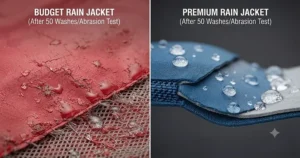
Buying the right jacket is only half the equation — how you treat it in the first month determines whether it performs like new for years or starts failing within one soggy season. Start by washing off the factory finish before first use with a technical wash (never regular detergent, which strips the durable water repellent, or DWR, coating); this single step is the most commonly skipped maintenance task and the biggest reason budget jackets seem to “wet out” faster than expected right out of the box. Reapply a wash-in or spray-on DWR treatment every 20-30 wears or once beading visibly slows, since DWR degradation — not membrane failure — is the number one reason both cheap and expensive rain jackets stop performing over time. Avoid the dryer on high heat unless your care label specifically allows a low tumble-dry to reactivate DWR, and never store a jacket damp or compressed in a stuff sack for more than a day or two, since trapped moisture accelerates seam-tape breakdown. A common first-30-days mistake is over-tightening the hood and hem cinches, which stresses the drawcord anchor points; adjust gently and let the elastic do the work. Finally, hang-dry rather than fold-store between uses — it’s a thirty-second habit that meaningfully extends the working life of even the Frogg Toggs Ultra-Lite2.
Real-World Scenarios: Which Jacket Fits Your Life
Picture three different people standing at a bus stop in the rain. The first is a university student in Halifax who bikes to campus twice a week and needs something that survives being stuffed into a backpack — for them, the Columbia Watertight II or Marmot PreCip Eco covers 90% of real-world scenarios without the guilt of an expensive purchase sitting unused. The second is a nurse in Vancouver who walks to shift work in genuinely relentless coastal rain, rain or shine, twelve months a year; for that kind of daily, sustained exposure, the cost-per-wear math tips hard toward the Rab Downpour Plus 2.0 or Patagonia Torrentshell 3L, since the extra membrane durability pays for itself within a single wet season. The third is a trail runner training year-round through the Rockies foothills, moving fast enough that breathability and hood security in high wind genuinely matter to safety, not just comfort — that’s the buyer for whom the Arc’teryx Beta SL stops being a luxury and starts being appropriate gear. None of these people are wrong; they’re just solving different problems, and matching your actual rain exposure to the jacket’s actual design intent is the single biggest factor in whether a purchase “feels worth it” six months later.
How to Choose Between a Cheap and Expensive Rain Jacket
Making this decision well comes down to a handful of concrete questions rather than gut feeling. Here’s the reasoning, step by step:
- Estimate your annual wear-days honestly. If you’ll wear it fewer than 20 days a year, premium membranes rarely pay for themselves — a budget jacket wins on cost-per-wear almost every time.
- Check your climate’s rain intensity, not just frequency. Coastal cities like Vancouver see sustained, heavy rain, which stresses budget membranes far more than the light, intermittent showers common inland.
- Weigh breathability against activity level. If you’re sedentary in the jacket (commuting, errands), a 2 or 2.5-layer shell is fine; if you’re hiking or cycling hard, 3-layer membranes prevent the clammy sweat-soak that ruins cheaper jackets.
- Factor in durability needs, not just waterproofing. Frequent contact with branches, backpack straps, or rough surfaces favours tougher, pricier face fabrics that resist abrasion.
- Consider your climate’s seasonality. A jacket used four months a year ages differently than one worn nine months a year — heavier use justifies the DWR and seam-tape quality of premium builds.
- Price in replacement cost over time. A C$90 jacket replaced every two seasons can cost more over five years than a single C$260 jacket that lasts the whole stretch — this is the core of the longevity testing math below.
- Be honest about resale and layering needs. If you need one jacket to double as a light shell over a fleece in shoulder seasons, the cut and room-to-layer on mid-range and premium jackets tends to be more forgiving.
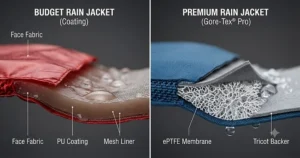
Budget Rain Jacket vs Premium: What Actually Changes at Each Price Tier
| Feature | Budget (Under C$150) | Premium (C$250+) |
|---|---|---|
| Membrane layers | 2 or 2.5-layer | Full 3-layer construction |
| Hydrostatic head | 5,000-10,000mm | 10,000-28,000mm |
| Seam sealing | Basic taped seams | Fully critically taped seams |
| Fit refinement | Boxy, generic sizing | Tailored, athletic cut |
| Typical lifespan | 1-3 wet seasons of regular use | 4-8+ wet seasons of regular use |
| Best For | Frogg Toggs Ultra-Lite2, Columbia Watertight II | Patagonia Torrentshell 3L, Arc’teryx Beta SL |
The honest takeaway from this table is that price buys durability and refinement far more than it buys “waterproofness” in the narrow sense — a C$40 jacket and a C$600 jacket can both keep you dry on day one. What separates them is how they perform on day 100, in wind, after a dozen washes, and whether the seams are still sealed two winters from now. If your main question is short-term dryness, budget jackets punch well above their price; if your question is long-term reliability, the gap widens fast.
Rain Jacket Price Comparison: Where Your Money Actually Goes
It’s tempting to assume a C$600 jacket is fifteen times “better” than a C$40 one, but that’s not really how the economics work. Roughly speaking, the jump from ultra-budget to budget (like Frogg Toggs Ultra-Lite2 to Columbia Watertight II) mostly buys fabric durability and a real membrane instead of a coated poncho-grade shell. The jump from budget to mid-range (Columbia Watertight II to Marmot PreCip Eco or North Face Venture 2) buys features — pit zips, better hoods, recycled materials — and modestly better hydrostatic head numbers. The real inflection point is mid-range to premium (Rab Downpour Plus 2.0 or Patagonia Torrentshell 3L to Arc’teryx Beta SL), where you’re paying for proprietary membrane technology (Gore-Tex ePE versus generic polyurethane laminates), tailored patterning that took real engineering time, and manufacturing quality control that reduces seam failures. What most buyers overlook is that the last 20% of price often buys the last 5-10% of performance — real, but disproportionately expensive, which is exactly why the “worth it” answer depends so heavily on your personal wear frequency rather than a universal rule.
Is Expensive Rain Gear Worth It? The Performance-Per-Dollar Breakdown
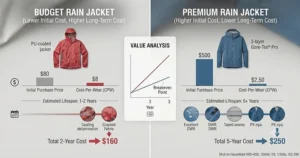
Here’s the honest answer: it depends entirely on performance per dollar for your specific use case, not on which jacket is objectively “better.” If you divide each jacket’s approximate price by its realistic lifespan in wet-weather days, the math tells a more interesting story than the sticker price alone. The Marmot PreCip Eco, at roughly C$150 and a realistic 150-200 wet-weather days of life under regular use, works out to under a dollar per wear — genuinely excellent performance per dollar. The Arc’teryx Beta SL, at roughly C$650, needs to be worn 300+ days across its lifespan (very achievable for a daily-rain-climate resident, much harder for an occasional user) to land in a similar cost-per-wear range. Reviewers consistently note that premium jackets retain waterproofing and breathability further into their lifespan — meaning a five-year-old Arc’teryx Beta SL often outperforms a five-year-old Columbia Watertight II by a wide margin, even though both started dry. So expensive rain gear is worth it specifically when your wear frequency is high enough to amortize the price, and not worth it when a jacket will spend most of its life in a closet.
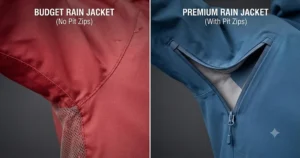
Longevity Testing: How Cheap and Expensive Jackets Age Over Time
Longevity is where the cheap-vs-expensive gap becomes most visible, and it’s rarely about the day-one waterproof rating — it’s about DWR degradation, seam-tape adhesion, and face-fabric abrasion resistance over dozens of wash-and-wear cycles. Budget jackets like the Frogg Toggs Ultra-Lite2 and Columbia Watertight II tend to show their age within one to two wet seasons of regular use: DWR beading slows noticeably, interior coatings can start to flake or peel (a process called delamination), and seam tape edges begin to lift at stress points like the underarms and hood seams. Mid-range options such as the Marmot PreCip Eco and North Face Venture 2 typically hold up for two to four seasons before similar wear becomes noticeable, aided by slightly more robust seam construction. Premium shells like the Patagonia Torrentshell 3L and especially the Arc’teryx Beta SL are built with more abrasion-resistant face fabrics and higher-quality seam tape that reviewers and long-term owners consistently report lasting five to eight years or more with proper care — the maintenance routine outlined earlier in this guide matters just as much as the jacket’s starting price tag. The practical lesson: longevity is partly bought with money and partly earned with care, and neglecting DWR maintenance can turn an expensive jacket into a two-season disappointment just as easily as it happens with a budget one.
Value for Money: Cost-Per-Wear Math for Rain Jackets
| Jacket | Price (CAD) | Est. Lifespan (wet-weather days) | Approx. Cost Per Wear |
|---|---|---|---|
| Frogg Toggs Ultra-Lite2 | C$35-50 | 30-50 days | ~C$0.80-1.20 |
| Columbia Watertight II | C$75-100 | 80-120 days | ~C$0.75-1.00 |
| Marmot PreCip Eco | C$140-170 | 150-200 days | ~C$0.80-1.00 |
| North Face Venture 2 | C$170-200 | 150-200 days | ~C$0.95-1.15 |
| Rab Downpour Plus 2.0 | C$220-260 | 200-280 days | ~C$0.90-1.10 |
| Patagonia Torrentshell 3L | C$250-290 | 250-350 days | ~C$0.80-1.00 |
| Arc’teryx Beta SL | C$600-680 | 400-600 days | ~C$1.10-1.50 |
Looking at the table above, the surprising finding is that cost-per-wear is remarkably flat across most of this lineup — somewhere between C$0.75 and C$1.50 per wear-day, regardless of sticker price, as long as you’re actually using the jacket at the frequency it’s designed for. The Marmot PreCip Eco and Patagonia Torrentshell 3L stand out as particularly strong value plays, delivering low cost-per-wear at very different price points because their lifespans scale roughly with their price. The Arc’teryx Beta SL only edges into “worse value” territory here because it requires genuinely heavy, near-daily use to justify — a reminder that value for money is a function of your habits, not just the jacket’s build quality.
✨ Don’t Miss These Exclusive Deals!
🔍 Whichever tier fits your budget, check current pricing and availability before you commit — stock and price ranges shift often, and a jacket sitting in your size today might not be there next week.
Common Mistakes When Buying a Rain Jacket
Even careful shoppers fall into a handful of predictable traps. The most common is fixating on the highest hydrostatic head number without considering breathability — a 20,000mm jacket that doesn’t vent well can leave you just as damp from sweat as a leaky budget shell leaves you from rain. A second mistake is buying based on brand reputation alone; as this guide shows, the Marmot PreCip Eco frequently outperforms pricier competitors on pure value, so brand name isn’t a reliable shortcut. Third, buyers often skip trying the jacket on with layers underneath, then find it too tight to wear over a fleece in shoulder-season weather — sizing up slightly is usually the safer call for anything but a summer-only shell. Fourth, many shoppers ignore hood design entirely, even though a poorly cinching hood in wind-driven rain can undermine an otherwise excellent membrane; the Arc’teryx Beta SL‘s adjustment system earns its reputation here precisely because this detail is so often overlooked. Finally, a subtle but costly mistake is neglecting DWR maintenance from day one, which — as covered in the longevity section above — can shrink even a premium jacket’s working life down to budget-jacket territory within a couple of seasons.
Rain Jacket Safety, Regulations & Materials Guide
Rain jacket shopping in Canada increasingly intersects with chemical safety regulation, and it’s worth understanding before you buy. Many waterproof-breathable membranes have historically relied on PFAS (“forever chemicals”) for their durable water repellent coatings, but Health Canada and Environment and Climate Change Canada have been moving to restrict PFAS as a class across consumer products, including textiles, with new federal rules phasing in through 2026. This matters practically: several jackets on this list, including the Patagonia Torrentshell 3L, are already PFC-free, positioning them ahead of the regulatory curve, while budget brands have been slower and inconsistent in disclosing their finish chemistry. If PFAS exposure is a concern for you or your family, look specifically for “PFC-free” or “fluorine-free DWR” on the product listing rather than assuming any given price tier is automatically cleaner. On the safety side, CSA-certified reflective elements aren’t standard on casual rain jackets but are worth seeking out if you’ll be walking or cycling near traffic in low light, since none of the seven jackets reviewed here include high-visibility certification by default. As with any wet-weather gear, layering matters for hypothermia prevention in cold rain — a jacket alone, budget or premium, is not a substitute for proper moisture-wicking base layers in near-freezing conditions.
FAQ
❓ Is a cheap rain jacket good enough for everyday use?
❓ How much more waterproof is an expensive rain jacket?
❓ What's the average lifespan of a budget vs premium rain jacket?
❓ Do expensive rain jackets breathe better than cheap ones?
❓ Are PFAS-free rain jackets as waterproof as older PFAS-treated ones?
Conclusion
So — cheap vs expensive rain jacket, worth it or not? The honest answer, after comparing seven real jackets across every metric that actually matters, is that both tiers earn their price when matched to the right person. The Frogg Toggs Ultra-Lite2 and Columbia Watertight II deliver genuinely strong performance per dollar for occasional or casual use, while the Marmot PreCip Eco sits in that rare sweet spot where budget pricing meets mid-range performance. Step up to the North Face Venture 2 or Rab Downpour Plus 2.0 for daily reliability without alpine pricing, and reserve the Patagonia Torrentshell 3L or Arc’teryx Beta SL for genuinely frequent, sustained wet-weather use where the cost-per-wear math actually favours them. The real lesson from the longevity and value-for-money breakdowns above isn’t that expensive is always better — it’s that matching wear frequency to jacket tier, and maintaining the DWR coating regardless of price, matters more than the number on the price tag.
Recommended for You
- Rain Jacket Vs Poncho Hiking: 7 Best Picks Compared (2026)
- 7 Best Emergency Rain Poncho Bulk Picks for Canadians in 2026
- 7 Best Ripstop Rain Ponchos in 2026
Disclaimer: This article contains affiliate links. As an Amazon Associate, I earn from qualifying purchases. If you purchase products through these links, we may earn a small commission at no additional cost to you.
✨ Found this helpful? Share it with your friends! 💬🤗
