
In This Article
Ask any Vancouverite standing in a September downpour whether their rain jacket choice matters — and they’ll give you a very wet, very direct answer. Choosing between a 3 layer vs 2.5 layer rain jacket isn’t just a technical debate for gear nerds; it’s a genuinely practical decision that affects how comfortable, dry, and miserable-free your Canadian outdoor life is going to be.
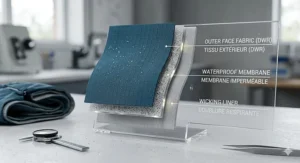
Here’s the short version you’re probably looking for: a 3-layer (3L) jacket bonds all three components — outer face fabric, waterproof membrane, and an inner liner — together into one unified, breathable shell. A 2.5-layer (2.5L) jacket skips that full inner liner and instead uses a thin printed or sprayed-on coating to protect the membrane from the inside. That “half layer” saves weight and cost, but it comes with real trade-offs in durability and comfort.
What most Canadian buyers overlook is how dramatically these differences play out in our specific climate. Whether you’re trudging through Vancouver’s relentless autumn rain, battling spring slush in Edmonton, or hiking Banff’s trails as weather turns on a dime — understanding rain jacket construction could be the difference between an enjoyable outing and a soggy disaster.
In this guide, I’ll break down exactly how these two construction types compare across waterproofing, breathability, durability, packability, and price (in CAD), then walk you through seven of the best jackets currently available on Amazon.ca. I’ll also tell you what the spec sheets won’t — because that’s where the real buying wisdom lives.
Quick Comparison: 3L vs 2.5L Rain Jackets at a Glance
| Feature | 3-Layer (3L) | 2.5-Layer (2.5L) |
|---|---|---|
| Construction | Face fabric + membrane + bonded inner liner | Face fabric + membrane + sprayed/printed coating |
| Breathability | Excellent — best for high output | Moderate — adequate for casual use |
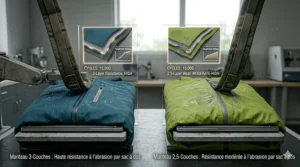
| Durability | High — integrated liner protects membrane | Lower — coating can wear or delaminate |
| Weight | Slightly heavier (typically 400–600g) | Lighter (typically 250–450g) |
| Packability | Moderate — bulkier when stuffed | Very packable — often stuff-sack friendly |
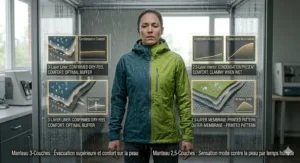
| Next-to-skin feel | Soft, smooth, non-clammy | Can feel sticky during high exertion |
| Price Range (CAD) | $180–$700+ | $120–$320 |
| Best For | Hiking, skiing, active commuting | Emergency backup, travel, casual use |
What this table tells you: The 2.5L wins on packability and price, making it a great “throw in your pack just in case” option — but if you’re regularly spending hours in wet, windy conditions (hello, coastal BC or spring shoulder season in Ontario), the 3L’s comfort and durability advantages are absolutely worth the premium. For most active Canadian outdoor enthusiasts, 3L construction delivers noticeably better value over time when you factor in longevity and comfort.
💬 Just one click — help others make better buying decisions too! 😊
✨ Don’t Miss These Exclusive Deals!
🔍 Take your rain protection to the next level with these carefully selected jackets. Click on any highlighted item to check current pricing and availability on Amazon.ca. These tools will help you stay genuinely dry — not just technically waterproof!
Top 7 Rain Jackets for Canadians: Expert Analysis (3L & 2.5L Options)
1. Patagonia Torrentshell 3L Rain Jacket
The Torrentshell 3L has quietly become the benchmark against which every other mid-range shell is measured, and for good reason. Built with Patagonia’s H2No® Performance Standard 3-layer construction, it bonds a recycled nylon face fabric, a waterproof/breathable membrane, and a smooth tricot-feel inner liner into one cohesive shell that handles prolonged rain beautifully.
The H2No membrane is fully PFAS-free — relevant to Canadian buyers because as environmental standards tighten, forward-thinking gear is already compliant. The jacket features fully taped seams, a two-way adjustable hood with a laminated visor, pit zips for ventilation, and a microfleece-lined collar that stops the cold from creeping in at the neck. For a Canadian spring hike where temperatures are hovering around 8°C (46°F) and the rain is relentless, that collar detail matters more than you’d think.
What most buyers miss: the Torrentshell isn’t the most breathable jacket in the 3L category — Patagonia clearly prioritized durability and waterproofing here. It’s an exceptional choice for hikers, backpackers, and daily commuters who need reliable protection, but if you’re ski touring or running trails at high output, you’ll want to consider something with higher breathability like the Arc’teryx Beta.
Canadian customers consistently praise the fit (true to size, room for a mid-layer fleece) and the fact that it keeps them genuinely dry in extended BC-style downpours. The recycled materials are also a major selling point for environmentally conscious Canadian shoppers.
✅ Excellent waterproofing for multi-hour rain exposure
✅ PFAS-free construction — future-proof for tightening Canadian standards
✅ Packs into its own pocket for travel
❌ Slightly stiff, crinkly fabric compared to softer 3L alternatives
❌ Breathability is adequate rather than exceptional for high-exertion use
Price range: Around $250–$290 CAD |
Value verdict: Exceptional 3L value that punches well above its price tier — this is the jacket most Canadians should buy first.
2. Arc’teryx Beta Jacket
If the Torrentshell is the reliable Honda Civic of rain jackets, the Arc’teryx Beta is the BMW — precision-engineered, premium-priced, and immediately noticeable in performance. Built with Gore-Tex 3-layer construction and Arc’teryx’s legendary fit, the Beta is designed for serious mountain users who refuse to compromise.
The jacket uses Gore-Tex Pro (in some variants) or standard Gore-Tex, which offers waterproof ratings exceeding 28,000mm hydrostatic head — overkill for most rain, but absolutely necessary for sustained alpine conditions where wet snow, ice crystals, and wind combine to test any membrane’s limits. Arc’teryx’s proprietary WaterTight zipper technology means there’s no separate zipper flap required, keeping the design sleek and the weight down.
Here’s the real-world Canadian insight: if you’re skiing inbounds at Whistler or doing multi-day backcountry hut trips in the Rockies, the Beta’s breathability (measured at 40,000+ g/m²/24h in the Pro version) means you’re not sweating into a clammy interior during boot packs or aggressive skinning. The breathability gap between the Beta and a mid-range 3L is genuinely noticeable during hard efforts.
Canadian reviewers note this is the jacket that “just works” regardless of what the weather throws at it — but the price requires commitment.
✅ Best-in-class breathability for high-output activities
✅ Industry-leading hood design — praised for visibility and coverage
✅ Exceptional long-term durability — outlasts multiple cheaper jackets
❌ Significant premium price — in the $600–$750+ CAD range
❌ Minimalist pockets and fit — not ideal for urban commuters
Price range: $600–$750+ CAD |
Value verdict: Expensive, but for serious alpine or backcountry Canadian use, the cost-per-use math works out over many seasons.
3. Helly Hansen Verglas Infinity Shell 2.0
Helly Hansen has been dressing Scandinavian fishermen, sailors, and mountain guides for over 140 years — and that heritage shows in the Verglas Infinity Shell 2.0. Built with Helly Tech® Professional membrane in a 3-layer configuration, this jacket offers bombproof weather resistance with a premium feel that rivals Gore-Tex offerings at a slightly more accessible price.
The Verglas Infinity 2.0 features Helly Hansen’s proprietary Lifa Infinity Pro® — a PFC-free membrane that maintains water repellency through the life of the garment without needing reproofing. For Canadian buyers, this is a significant practical advantage: you’re not re-DWR-treating your jacket every season. The jacket passed independent shower tests without allowing a single drop through, including completely dry pockets — the kind of real-world detail that matters when you’re hiking in coastal Newfoundland or camping through an Ontario summer storm.
The construction is notably thicker and heavier than the Torrentshell, which translates to durability but less packability. Think of this as your do-everything mountain jacket rather than your ultralight travel shell. Canadians who fish, ski, or work outdoors consistently rate this among the most reliable shells they’ve owned.
✅ Durable construction — handles rough conditions and repeated washing
✅ Lifa Infinity Pro® means no reproofing required — excellent for busy Canadians
✅ Outstanding waterproofing in independent testing
❌ Heavier and less packable than competitors
❌ Stiffer fabric can restrict movement during dynamic activities
Price range: $400–$500 CAD |
Value verdict: Premium but worth it for Canadians who need an all-purpose jacket that handles ski season, shoulder season, and everything in between.
4. Outdoor Research Foray 3L Jacket
The Outdoor Research Foray earned its reputation by being the kind of jacket that never lets you down — even when it quietly upgraded from 2.5L to 3L construction, signalling OR’s confidence in the technology. Built with Gore-Tex 3L fabric, the Foray is notably softer and more supple than stiff alternatives like the Torrentshell, which makes it surprisingly comfortable for full-day wear.
The Foray’s Gore-Tex membrane provides that trusted 28,000mm+ waterproofing with genuine breathability, and the 3-layer construction’s integrated liner means there’s no clammy sticking to your skin — particularly welcome during BC shoulder season hikes where you’re sweating on climbs and getting rained on during descents. The helmet-compatible hood adjusts with one hand, which sounds minor until you’re trying to tighten your hood in sideways sleet with gloved hands.
From a Canadian perspective, the Foray fits well over a mid-layer fleece — critical for layering systems in variable Canadian temperatures — and the articulated patterning gives excellent freedom of movement for scrambling or snowshoeing. CNN Underscored ranked it as the top choice for anyone who regularly spends hours in serious precipitation.
✅ Noticeably soft, supple 3L fabric — most comfortable wear of the group
✅ Excellent breathability for sustained hiking
✅ Helmet-compatible hood — great for backcountry skiing and climbing
❌ Premium price point
❌ No pit zips — ventilation relies entirely on membrane breathability
Price range: $350–$450 CAD |
Value verdict: The softest, most wearable 3L option in this list — ideal for Canadian hikers and trekkers who spend full days in variable weather.
5. Marmot PreCip Eco Jacket (2.5L)
Not everyone needs a $400 shell — and the Marmot PreCip Eco Jacket makes an honest, well-engineered case for 2.5L construction as the budget-conscious Canadian’s best friend. Built with Marmot’s NanoPro™ 2.5L technology — 100% recycled nylon ripstop rated at 10,000mm waterproofing and 17,000 g/m²/24h breathability — this jacket covers the basics without pretending to be something it’s not.
The spec that matters most here: 10,000mm is waterproof by any legitimate standard. Where the PreCip Eco shows its 2.5L limitations is in extended, high-output use — the sprayed-on interior coating means it can feel slightly clammy during a sustained uphill push compared to a 3L alternative. But for the average Canadian hiker doing day trips in the shoulder season, occasional commuting, or camping trips where the jacket spends most of its time in your pack, the PreCip Eco performs admirably.
The PitZips are a thoughtful addition that partially compensates for the breathability gap — you can dump heat quickly on steep climbs even if the membrane isn’t as active as a 3L design. The jacket stuffs into its own pocket and is readily available on Amazon.ca at a price point that doesn’t require a second mortgage.
✅ Exceptional value — serious waterproofing at an accessible price
✅ 100% recycled nylon — eco-conscious choice for sustainability-minded Canadians
✅ Pit zips help manage ventilation
❌ 2.5L coating can feel clammy in sustained high-output use
❌ Lighter construction means lower long-term durability than 3L alternatives
Price range: $130–$180 CAD |
Value verdict: The go-to choice for budget-focused Canadians who need solid rain protection without 3L pricing — excellent starter jacket or backup shell.
6. Columbia Watertight II Jacket (2.5L)
Columbia’s Watertight II is one of the most recognized rain jackets on Amazon.ca — and with good reason. It’s approachable, available in a wide size range (XS to 3XL), and uses Columbia’s Omni-Tech® waterproof-breathable membrane in 2.5L configuration. Think of it as the practical workhorse that doesn’t ask for much attention but quietly keeps you dry during Toronto commutes, dog walks on rainy Sunday mornings, and camping trips where weather turns unexpectedly.
The Omni-Tech membrane provides solid waterproofing with fully seam-sealed construction — everything you need for Canadian urban and casual outdoor use. Where it shows 2.5L limitations is in sustained activity: the sprayed-on inner doesn’t have the smooth next-to-skin feel of a 3L liner, and on a hot humid day, you’ll notice the difference. But for the price, this is genuinely hard to argue with.
For Canadians shopping on a strict budget or looking for a reliable daily jacket that doesn’t take up closet space, the Watertight II is a no-brainer. It’s widely Prime-eligible on Amazon.ca, typically with free shipping for Prime members or orders over $35 CAD.
✅ Wide size range — accessible for all body types
✅ Widely available on Amazon.ca with Prime eligibility
✅ Packable and lightweight — easy to carry as backup
❌ Basic feature set — no pit zips, limited hood adjustability
❌ Less durable than 3L options over extended hard use
Price range: $80–$130 CAD |
Value verdict: Best entry-level rain jacket for Canadian city dwellers and casual outdoorists — reliable protection without the investment.
7. Montbell Versalite 3L Jacket
Montbell is Japan’s answer to Arc’teryx — obsessively engineered, ultralight, and relatively unknown to most Canadians, which is precisely why it deserves a spot on this list. The updated Versalite uses Montbell’s proprietary SUPER DRY-TEC 3L waterproof membrane in a 3-layer configuration that prioritizes weight savings above all else. This is the jacket for thru-hikers, ultralight backpackers, and anyone for whom grams genuinely matter.
At under 200g for some sizes, the Versalite is remarkable — it achieves 3-layer construction without the typical weight penalty, making it genuinely viable as a running and fast-hiking shell where most 3L jackets feel too heavy. The PFAS-free DWR finish also keeps it legal in jurisdictions tightening chemical regulations, which matters increasingly for Canadian outdoor retailers stocking it.
What you trade for the weight savings: the Versalite’s ultra-minimal design means no pockets on the newest model — a real compromise for most Canadian users who need to store gloves, phones, and snacks. It’s also pricier than its weight class would suggest. But for the right Canadian athlete, there’s nothing else quite like it.
✅ Ultralight 3L construction — exceptional for long-distance hiking and trail running
✅ PFAS-free and environmentally forward
✅ Compresses to almost nothing in a pack
❌ Newest model has no pockets — a significant practical limitation
❌ Premium price for an ultraminimalist shell
Price range: $280–$380 CAD |
Value verdict: Niche pick for ultralight-focused Canadians — unmatched if weight is your primary concern, but too minimalist for most everyday use.
Canadian Weather Reality Check: How to Choose the Right Construction
One thing gear reviews rarely acknowledge honestly: Canadian weather is not one thing. It’s a dozen things, depending on province, elevation, and season. Here’s a practical framework for matching jacket construction to your actual Canadian conditions.
3L Is the Right Choice If You…
- Regularly hike, ski, or cycle in sustained rain or wet snow. The 3L’s integrated liner means no clamminess during multi-hour efforts, and the superior breathability handles the temperature fluctuations you get on coastal BC trails or Rocky Mountain ridgelines.
- Live in the Lower Mainland, Victoria, or any coastal region. Rain in coastal BC isn’t a quick shower — it’s hours of steady, sideways precipitation. A 2.5L coating can degrade faster under this kind of sustained exposure; a 3L liner is mechanically protected and far more durable.
- Plan to use the jacket for 3+ seasons per year. The 3L construction’s durability means it outlasts 2.5L alternatives by years of regular use, making the higher upfront cost in CAD the cheaper long-term choice.
- Sweat significantly during outdoor activities. The breathability gap is real and noticeable. If you’ve ever finished a hike feeling wetter from sweat than from rain, a 3L jacket — particularly with a high-breathability membrane — is the direct solution.
2.5L Is the Smart Choice If You…
- Want emergency rain protection without pack weight. The 2.5L’s light weight and high packability make it ideal as a just-in-case layer for summer hikes where rain is unlikely but possible.
- Are on a strict budget. At $80–$180 CAD versus $250–$700+ for 3L options, 2.5L jackets provide genuine protection at a fraction of the cost. For students, occasional hikers, and urban commuters, this is entirely reasonable.
- Travel frequently and need one compact layer. When you’re flying to Calgary for a long weekend in May, a 2.5L jacket that stuffs into a shirt pocket is more practical than a heavier 3L shell.
The Canadian Climate Factor
Cold temperatures affect this decision in a non-obvious way: below about 5°C (41°F), the vapour pressure differential that drives breathability in Gore-Tex and similar membranes becomes less effective. In very cold, dry Canadian winters, the breathability advantage of premium 3L membranes partially diminishes — which means a warm mid-layer plus a durable 2.5L shell can be entirely adequate for cold-weather Canadian hiking. For shoulder season (March–May and September–November) where temperatures fluctuate widely and precipitation is heavy, the 3L’s consistent breathability and durability earns its price premium decisively.
Real-World Canadian User Profiles: Which Jacket Fits Your Life?
Understanding construction is one thing. Knowing which jacket actually fits your lifestyle is another. Here are three Canadian user scenarios that illustrate the decision in practice.
Profile 1: The Metro Vancouver Commuter-Hiker
Sarah, a 34-year-old living in East Vancouver, cycles to work three days a week and hikes the North Shore mountains on weekends. She’s out in rain from October through May — essentially half the year. Her budget is around $250–$300 CAD.
Best pick: The Patagonia Torrentshell 3L. For Sarah, durability and comfort over long periods matter more than packability or ultralight weight. The 3L construction handles her sustained exposure to coastal BC rain without delaminating or getting clammy during her 30-minute bike commute. The PFAS-free construction aligns with her environmental values, and the jacket fits over a hoodie for chilly morning rides.
Profile 2: The Intermittent Alberta Adventurer
Tom, 52, lives in Calgary and camps 5–6 times per year, mostly in the Rockies from June to September. Weather is unpredictable but rarely sustained all-day rain. He wants something packable that won’t weigh down his pack. Budget: under $180 CAD.
Best pick: The Marmot PreCip Eco Jacket (2.5L). Tom doesn’t need a $350 3L shell for weekend adventures where serious rain is occasional rather than constant. The PreCip Eco’s 10,000mm waterproofing handles Rocky Mountain afternoon thunderstorms effectively, stuffs into its own pocket, and leaves budget for the rest of his kit. The recycled nylon construction also fits the conservation-minded culture of Alberta’s outdoor community.
Profile 3: The Serious Backcountry Skier
Jess, 28, based in Canmore, Alberta, skis backcountry 25–30 days per winter and wants one hardshell that handles everything from skinning boot packs to riding down in wet spring snow. Budget: $500–$700 CAD.
Best pick: The Arc’teryx Beta Jacket. For Jess, breathability during high-effort skinning isn’t a nice-to-have — it’s physiologically essential. The Beta’s 3L Gore-Tex Pro breathability (40,000+ g/m²/24h) keeps moisture moving during hard uphills, and the bomber construction handles the abrasion of crampons, ice tools, and rocky terrain that would destroy a 2.5L jacket in a season. The premium price is simply the cost of serious mountain performance.
Layer Technology Differences: What the Spec Sheet Won’t Tell You
The rain jacket industry loves breathability numbers. You’ll see “20,000 g/m²/24h” plastered on product pages without any context for what that actually means during a rainy Tuesday hike in Algonquin Park. Here’s the translation guide you actually need.
Breathability Ratings Decoded
According to outdoor gear research, breathability is measured in grams of moisture vapour that can pass through one square metre of fabric in 24 hours. The practical benchmarks are:
- Under 5,000 g/m²/24h: Essentially non-breathable. Fine for standing in rain, not fine for moving in it.
- 10,000–15,000 g/m²/24h: Adequate for low-to-moderate activity. Your PreCip Eco territory — good for hiking but sweaty during hard efforts.
- 20,000–30,000 g/m²/24h: High performance. Handles moderate-to-vigorous hiking comfortably in most conditions.
- 40,000+ g/m²/24h: Premium performance. Arc’teryx Beta territory — designed for ski touring, running, and climbing where you’re generating serious heat.
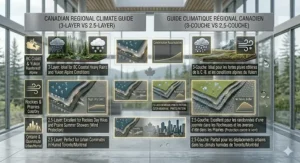
The critical nuance for Canadians: breathability ratings are measured under ideal laboratory conditions. In humid summer rain (like Ontario or Quebec in July), the moisture differential between inside and outside the jacket narrows, and all membranes breathe less effectively. In cold, dry conditions — think a Rocky Mountain ridgeline in October — Gore-Tex membranes breathe more effectively because the temperature and vapour pressure differential is greater. Understanding this means you can set realistic expectations for your specific Canadian environment.
Why Major Brands Are Abandoning 2.5L
An interesting market shift has occurred in the past few years: major brands like Arc’teryx and Patagonia have discontinued their 2.5-layer rain shells, replacing them entirely with 3-layer designs. Outdoor Research updated the popular Foray from 2.5L to 3L construction. When every major player moves in the same direction simultaneously, it tells you something definitive about where the technology trade-offs land.
The industry consensus: 2.5L’s weight and packability advantages don’t compensate for its durability limitations in serious use. A 3L jacket at 450g feels meaningfully different from a 2.5L at 320g only when you’re counting every gram — for most users, the 130g difference is irrelevant, and the superior liner feel and longevity of 3L construction is worth every ounce.
Waterproofing: How Much Is Enough?
There’s a common misconception that higher waterproofing ratings always mean better jackets. In practice, any jacket rated above 10,000mm hydrostatic head provides complete protection against even heavy Canadian rain. The difference between 10,000mm and 28,000mm isn’t about whether water gets in — it’s about how quickly the seams, zippers, and DWR finish degrade under sustained pressure over time. A Gore-Tex jacket’s real advantage is longevity of performance, not simply day-one waterproofing that any decent 2.5L shell can match.
Common Buying Mistakes (And How to Avoid Them in Canada)
After years of watching people make the same jacket-buying errors, here are the most common pitfalls — with Canadian-specific context baked in.
Mistake 1: Buying for the Wrong Use Case
The most common and costly mistake: buying an ultralight 2.5L packable shell for regular use in sustained Canadian rain, or conversely, spending $700 on an Arc’teryx Beta for occasional dog walks in a Toronto drizzle. Be honest about how you actually use a jacket, not how you imagine you might use it. If you hike three times a year in fair weather conditions, a $130 2.5L Columbia is genuinely sufficient and smart.
Mistake 2: Ignoring DWR Maintenance
A $400 3L Gore-Tex jacket that hasn’t been DWR-treated in two years behaves like a $50 rain jacket. The outer face fabric “wets out” — it stops beading water — and instead of rolling droplets off, it absorbs them, dragging down breathability dramatically. This is Canada-specific in importance: winter road salt, pine sap from BC trails, and urban pollution all accelerate DWR degradation. Wash your jacket with a technical cleaner (Nikwax Tech Wash is widely available in Canada) and reapply DWR spray every season. It takes 20 minutes and extends your jacket’s life by years.
Mistake 3: Forgetting About Warranty Coverage in Canada
Cross-border warranty complications are a real Canadian issue. If you buy a jacket from a US retailer to save money on exchange rate, verify the brand services warranties in Canada before purchasing. Patagonia’s Ironclad Guarantee, Arc’teryx’s warranty, and Outdoor Research’s repair programs all operate in Canada — but buying from US Amazon and having a warranty issue can create headaches. Amazon.ca purchases of major brands typically come with Canadian warranty support.
Mistake 4: Overlooking the Fit-for-Layering Question
Canadian weather means layering — almost always. A rain jacket that fits perfectly over a T-shirt might be stranglingly tight over a mid-weight fleece in October. When purchasing online on Amazon.ca, check fit notes carefully: most quality jackets describe whether they’re designed for layering. The Patagonia Torrentshell, Helly Hansen Verglas, and Outdoor Research Foray all note generous layering room explicitly.
Mistake 5: Assuming Higher Price Always Means Better Waterproofing
It doesn’t. A $130 Marmot PreCip Eco will keep you as dry in a Canadian rainstorm as a $700 Arc’teryx Beta — on day one. The price premium in quality jackets buys durability, breathability, fit refinement, and longevity. If you’re buying once and keeping it for a decade, the premium makes financial sense. If you’re uncertain, start with a mid-range 3L and upgrade when you actually outgrow its limitations.
Long-Term Cost & Value Analysis in Canadian Dollars
Let’s talk about total cost of ownership — the number that actually matters for Canadian shoppers making a smart investment.
The 3L Economics
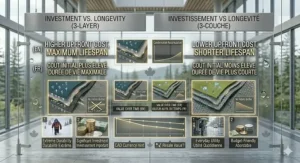
A quality 3L jacket in the $250–$400 CAD range, properly maintained, typically lasts 7–12 years of regular outdoor use. At $300 CAD over 10 years, you’re paying $30 per year for your rain jacket. If it lasts 12 years (common with Gore-Tex and H2No membranes), that’s $25/year. The integrated liner that protects the membrane from abrasion and body oils is directly responsible for this longevity — it’s not incidental to the 3L value proposition, it is the value proposition.
The 2.5L Economics
A solid 2.5L jacket in the $130–$200 CAD range typically delivers 3–5 years of regular use before the sprayed-on coating begins to delaminate or wear unevenly. At $160 CAD replaced every 4 years, you’re paying $40 per year. The 2.5L is more expensive long-term for active users, despite the lower sticker price.
The tipping point: If you use a rain jacket more than 20–25 days per year (common for coastal BC residents, serious hikers, outdoor workers), a 3L jacket is genuinely cheaper over a 5-year horizon. If you use it less than 10 days per year, a 2.5L at lower upfront cost makes better financial sense. Most Canadian shoppers fall somewhere in the middle — and for them, a mid-range 3L like the Torrentshell at around $260 CAD is the mathematically sound choice.
Canadian Price Premium Reality
Canadian buyers typically pay 15–25% more than US prices for the same jackets, reflecting import duties, exchange rate, and smaller retail market. The Patagonia Torrentshell that lists for USD $189 in the US market runs approximately $250–$290 CAD on Amazon.ca. This is frustrating but normal — and it underscores the importance of durability when making Canadian outdoor gear investments. Spending $260 CAD on a jacket that lasts a decade beats spending $130 CAD twice.
How to Choose a Rain Jacket in Canada: 7 Expert Steps
- Identify your actual use frequency and conditions. Be honest: casual weekend use in mild weather, or regular multi-hour exposure to serious Canadian precipitation? This single answer determines whether 2.5L or 3L is right for you.
- Set a realistic budget in CAD. Quality 3L protection starts around $250 CAD. Quality 2.5L starts around $130 CAD. Budget less than that and you’re in water-resistant territory, not truly waterproof.
- Check Amazon.ca availability and Prime eligibility. Canadian buyers benefit significantly from Prime shipping, especially in remote or northern communities where standard shipping can take weeks. Most major brands have Amazon.ca listings with Prime.
- Verify layering fit. Order one size up from your T-shirt size if you plan to wear a mid-layer underneath — standard practice for Canadian shoulder-season conditions.
- Consider your breathability needs honestly. If you run, cycle, ski, or hike at high effort levels, breathability matters enormously. Choose a membrane rated at least 20,000 g/m²/24h. Casual walkers and commuters can comfortably work with 10,000 g/m²/24h.
- Look for PFC-free DWR construction. Environment Canada is moving toward PFAS regulations aligned with European standards — PFC-free jackets like the Torrentshell 3L and PreCip Eco are already compliant and better for Canadian waterways.
- Factor in warranty and service availability in Canada. Patagonia, Arc’teryx (a Canadian company, proudly), Outdoor Research, and Helly Hansen all service warranties in Canada without cross-border complications.
FAQ
❓ Is a 3 layer rain jacket worth the extra cost in Canada?
❓ Can a 2.5 layer rain jacket handle Canadian winter conditions?
❓ Do 3 layer rain jackets require special washing care in Canada?
❓ What's the best rain jacket on Amazon.ca for under $200 CAD?
❓ Is Arc'teryx actually made in Canada?
Conclusion: The Verdict for Canadian Buyers
After everything, here’s the direct answer to the 3 layer vs 2.5 layer rain jacket question for Canadian buyers in 2026: for most people, most of the time, in most Canadian weather, a 3-layer jacket is the better investment.
The 3L’s integrated liner isn’t just a comfort upgrade — it’s the structural reason these jackets last longer, breathe better during activity, and hold their waterproofing more consistently over years of Canadian seasons. The fact that every major outdoor brand has moved away from 2.5L construction in their premium lines speaks louder than any spec comparison I could offer.
That said, the 2.5L earns its place. If your jacket spends most of its time in a stuff sack waiting for emergency duty, or if your budget simply doesn’t stretch to 3L pricing in CAD, a well-made 2.5L like the Marmot PreCip Eco gives you genuine rain protection without pretense.
The Canadian outdoor life — whether that’s dawn salmon fishing on the Skeena, shoulder-season hiking in Jasper, or commuting through a Halifax nor’easter — deserves gear that actually works. Know your conditions, know your budget, and choose accordingly. The right rain jacket isn’t the most expensive one on Amazon.ca. It’s the one that matches your specific Canadian life.
✨ Don’t Miss These Exclusive Deals!
🔍 Ready to find your ideal rain jacket? Click any highlighted product above to check current pricing and availability on Amazon.ca. Whether you’re shopping 3L or 2.5L, the right jacket for your Canadian weather is waiting.
Recommended for You
- 7 Best 3 Layer Hardshell Jackets Canada 2026
- Best 7 Packable Rain Jackets for Backpacking in Canada 2026
- 7 Best Ultra Light Packable Rain Jackets Under 200g in Canada (2026)
Disclaimer: This article contains affiliate links. As an Amazon Associate, I earn from qualifying purchases. If you purchase products through these links, we may earn a small commission at no additional cost to you.
✨ Found this helpful? Share it with your friends! 💬🤗
