
In This Article
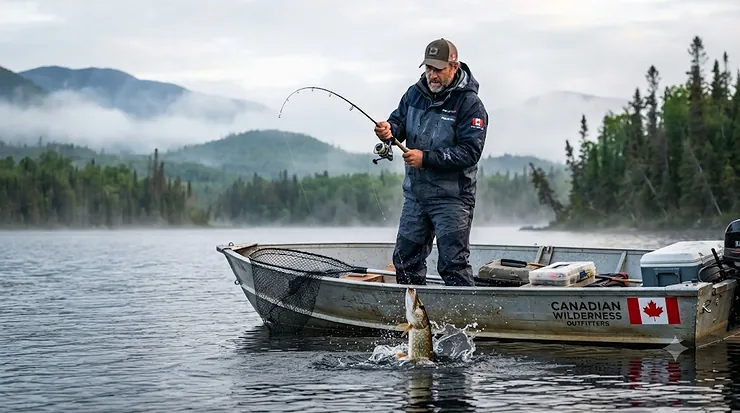
There’s a very specific kind of misery that comes from fishing in the wrong rain gear. Cold water finds the gap at your collar. It runs down your forearm every time you lift the rod tip. By hour two you’re not thinking about the walleye bite — you’re thinking about your truck heater. A good fishing rain suit is supposed to make that problem disappear entirely, and the honest truth is that most of them don’t, not really, not once the drizzle turns into a genuine downpour off Lake Erie or a squall rolling across the Strait of Georgia. Choosing a fishing rain suit is less about finding “waterproof” on a tag and more about understanding hydrostatic head ratings, seam construction, and where a given suit’s design choices quietly fall apart under real pressure.
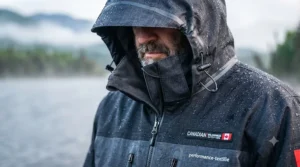
What is a fishing rain suit? It’s a purpose-built two-piece (or sometimes bibbed) outer layer engineered specifically for anglers — combining a waterproof-breathable shell, sealed seams, and fishing-specific features like plier pockets, kill-switch D-rings, and boat-deck-friendly cuffs that generic rainwear simply doesn’t offer.
This guide breaks down seven real, currently available fishing rain suits spanning budget to premium, with the kind of honest analysis you won’t get from a spec sheet alone. We’ll get into why waterproof fishing clothes fail where they fail, how tackle pocket design separates the merely dry from the genuinely functional, and what saltwater exposure does to hardware over a season on the coast. None of this is about which brand pays the biggest commission — it’s about matching the right angler rain suit to the water you actually fish, in the conditions Canada actually throws at you. For context on why this matters more than people assume, Transport Canada’s guidance on cold-water immersion is a sobering read for anyone who thinks a rain suit is just about comfort.
Quick Comparison Table
Before we dig into full reviews, here’s the fast version for anyone standing in a driveway with a weather app open and a boat trailer already hitched.
| Fishing Rain Suit | Best For | Approx. Waterproof Rating | Price Range (CAD) |
|---|---|---|---|
| Frogg Toggs Pilot II | Budget-conscious anglers, backup gear | 15,000mm | Around C$150–C$280 (full set) |
| Grundens Brigg 40 / Herkules 16 | Commercial-style abuse, cold-weather layering | 100% waterproof PVC | Around C$430–C$500 (full set) |
| AFTCO Barricade | Tournament anglers wanting balance | 20,000mm | Around C$620–C$700 (full set) |
| Simms Challenger | Freshwater guides, wader compatibility | High-end 2-layer laminate | Around C$550–C$650 (full set) |
| HUK Pro Series | Serious anglers, best pocket layout | 30,000mm | Around C$1,300–C$1,500 (full set) |
| Mustang Survival Taku | Saltwater, coastal BC anglers | Marine-spec 3-layer | Around C$750–C$900 (full set) |
| NRS Riptide | Kayak and river anglers | High hydrostatic head 3-layer | Around C$220–C$280 (jacket only) |
Looking at this spread, the pattern that jumps out is how little “waterproof” alone tells you. A budget suit like the Frogg Toggs Pilot II and a premium one like the HUK Pro Series can both claim you’ll stay dry, but they diverge hard on breathability, durability under repeated abrasion, and how the pockets are actually laid out for a day of casting and re-rigging. Anglers fishing occasional weekend trips have very different needs than someone logging 100+ days a season on saltwater, and the price gap here mostly reflects fabric technology and seam-sealing quality rather than marketing fluff.
💬 Just one click — help others make better buying decisions too! 😊
Top 7 Fishing Rain Suits: Expert Analysis
Every fishing rain gear review worth reading should tell you not just what a suit does, but who it’s actually built for. Here’s the honest breakdown of seven real products, spanning the full budget-to-premium spectrum.
1. Frogg Toggs Pilot II — best budget-friendly waterproof fishing suit
The Frogg Toggs Pilot II Guide Jacket and Bib pairing is the suit most anglers cut their teeth on, and for good reason: it’s genuinely functional rain protection at a fraction of what the premium brands charge. The DriPore Gen2 fabric layer carries a waterproof rating north of 15,000mm with breathability above 10,000 MVTR — numbers that, on paper, sit closer to mid-tier premium gear than to a dollar-store poncho. In practice, this means light-to-moderate rain and long humid days on the water won’t leave you clammy on the inside, which is where a lot of cheap rainwear quietly fails.
The bib features fully taped and sealed seams, comfort-stretch suspenders, and quick-drain expandable cargo pockets, while the jacket adds a vented, removable hood and a two-way splash-resistant zipper with an internal storm flap. Based on the spec comparison with entry-level competitors, the Pilot II punches well above its price bracket for a suit built primarily from polyester and a proprietary DriPore membrane rather than exotic laminates. What most buyers overlook about this line is the internal Co-Pilot liner attachment system, which lets the same shell double as cold-weather gear if you add an insulated layer separately — genuinely useful for anglers who fish spring through late fall without owning two separate suits.
Aggregated review sentiment for the Pilot II is consistently split along one line: anglers who fish in it occasionally love it, while those who wear it hard for full seasons report the zippers as the eventual failure point. Reviewers on outdoor forums repeatedly note that the bibs outlast the jacket, and that the line gets an unfair reputation from Frogg Toggs’ cheaper paper-like disposable suits, which share a brand but not a fabric class.
Pros:
- ✅ Genuinely waterproof and breathable for the price point
- ✅ Fully taped, sealed seams on both jacket and bib
- ✅ Lightweight enough to pack for spontaneous trips
Cons:
- ❌ Zippers are the most commonly reported failure point
- ❌ Sizing runs generously, so fit can feel baggy
Priced in the mid-C$100s for the jacket alone and around C$150–C$280 for the full set, at the time of research, the Frogg Toggs Pilot II delivers real value for anglers who need reliable protection without the premium-brand markup — just budget for a replacement zipper pull kit if you’re using it hard every weekend.
2. Grundens Brigg 40 / Herkules 16 — heaviest-duty PVC build on the market
If you want rain gear that feels like it could survive a boat deck getting power-washed with you still standing on it, the Grundens Brigg 40 jacket paired with the Herkules 16 bib is the closest thing to that promise. This is genuinely commercial-grade equipment — Grundens has outfitted commercial fishing crews since the mid-20th century, and the Herkules bib specifically dates its design lineage back to 1954. The fabric is a heavyweight PVC-coated cotton canvas, totalling roughly 18 oz per yard on the bib and around 15.6 oz per yard on the jacket, with the PVC formulated to resist fish oils and stay flexible in near-freezing temperatures.
Here’s what the spec sheet won’t tell you outright: this isn’t breathable gear in the technical sense that Gore-Tex or Toray laminates are. PVC-coated cotton is 100% waterproof through sheer material density rather than a microporous membrane, which means it holds up phenomenally well to abrasion, hook snags, and fish slime, but it will make you sweat during high-output casting on a warm day. Based on the spec comparison with laminate-based suits, this is squarely a cold-weather, low-mobility-tolerance choice — think ice-out walleye trips or November salmon runs, not a July bass tournament.
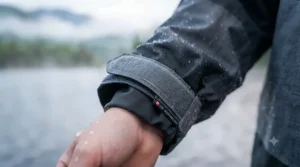
The Herkules bib’s reversible front-to-back design is a small but clever detail that extends wear life on the high-abrasion knee area, and the reinforced, riveted hems hold up under exactly the kind of gear-hauling abuse recreational suits weren’t built for.
Pros:
- ✅ Near-indestructible PVC construction resists oils and abrasion
- ✅ Reversible bib design extends the wear life of high-friction areas
- ✅ Stays flexible even in low temperatures, unlike cheaper PVC
Cons:
- ❌ Minimal breathability compared to laminate-based fishing suits
- ❌ Heavier and bulkier than technical rain gear alternatives
At around C$430–C$500 for the full jacket-and-bib combination, at the time of research, the Grundens Brigg 40 / Herkules 16 pairing is the value pick for anglers who prioritize sheer durability over all-day breathability — a workhorse rather than a technical shell.
3. AFTCO Barricade — best balance of protection and breathability
The AFTCO Barricade line sits in that sweet spot where tournament-grade performance meets a price that doesn’t require a second mortgage. Constructed with three-layer fabric rated around 20,000mm waterproof and 15,000g breathability, it’s built to handle sustained heavy rain during a full day of run-and-gun bass fishing without turning into a sweat lodge. The signature “SpeedVent” hood is specifically engineered to prevent ballooning at highway-speed boat runs, a detail that matters enormously more than it sounds once you’ve had a hood fill with air and yank your neck sideways at 45 mph.
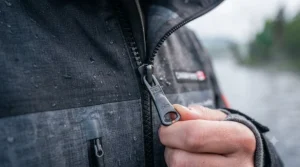
What most buyers overlook about the Barricade is the YKK AquaGuard zipper system — a composite build that resists saltwater corrosion, unlike standard metal zippers that pit and seize after repeated exposure. Elastic hem cinches keep the jacket close to the body to reduce water intrusion, and the “Double Dry” cuff system is designed specifically to stop water from creeping up the sleeve during casting and hook-setting motions, which is a genuinely common failure point on cheaper jackets.
Reviewers consistently report the Barricade as the gear they reach for over pricier options in their closet, citing the mobility-to-protection ratio as best-in-class for anglers who move constantly rather than sit still on a charter deck all day.
Pros:
- ✅ Corrosion-resistant YKK AquaGuard zippers built for saltwater
- ✅ SpeedVent hood prevents ballooning at high boat speeds
- ✅ Strong mobility for active, run-and-gun style fishing
Cons:
- ❌ Premium price relative to entry-level competitors
- ❌ Not quite as bombproof as heavier commercial-grade PVC suits
Expect to pay around C$620–C$700 for the complete jacket-and-bib set at the time of research, positioning the AFTCO Barricade as the value-conscious tournament angler’s pick — genuinely competitive with suits costing considerably more.
4. Simms Challenger — best for freshwater guides and wader compatibility
Simms has built its reputation over three decades primarily on waders, and that DNA shows clearly in the Simms Challenger rain suit’s fit and function. The jacket uses a recycled polyester two-layer Toray laminate with a C0 DWR finish, weighing in at roughly 652 grams for a men’s medium — genuinely light for the protection it offers. The three-way adjustable storm hood with a brim is a small design choice that matters enormously on fast-moving boats, since it maintains peripheral vision instead of collapsing over your eyes the moment the wind picks up.
Here’s what the spec sheet doesn’t fully capture: the Challenger is cut with extra length specifically so it layers cleanly over waders, which most fishing-specific rain suits genuinely don’t account for. Based on aggregated review sentiment, this is the suit fly anglers and wading guides gravitate toward precisely because it doesn’t bunch or ride up when paired with chest waders — a persistent complaint with rain gear designed primarily for boat decks. The zippered chest pocket with an interior sunglasses chamois is a thoughtful, if minor, touch that shows the design team actually fishes in the product.
Reviewers, including working guides, describe the fit as accommodating enough for mid-weight layering while still moving naturally through a full cast, and multiple owners specifically praised the jacket’s performance in sustained cold-water spray from boat wakes, not just overhead rain.
Pros:
- ✅ Cut specifically to layer cleanly over waders
- ✅ Three-way adjustable hood maintains visibility in wind
- ✅ Lightweight two-layer construction without sacrificing waterproofing
Cons:
- ❌ Premium price point relative to comparable two-layer suits
- ❌ Canadian buyers should note return policies differ from U.S. customers
At around C$550–C$650 for the jacket-and-bib set, at the time of research, the Simms Challenger earns its price primarily through fit engineering that recognizes anglers don’t just stand on flat boat decks — some of them wade.
5. HUK Pro Series — best tackle pocket design and storage layout
If tackle pocket design is your priority, the HUK Pro Series jacket and bib combination is genuinely the standout of this entire lineup. Built from premium Toray three-layer stretch nylon with a 30,000mm waterproof and 15,000g breathable rating, it’s tournament-tested gear designed with input from professional anglers who spend more days on the water in a season than most of us do in five years. The pocket layout alone justifies a close look: the bib includes two zippered chest pockets, cargo-style “water shield” thigh pockets, handwarmer pockets, and a dedicated plier pocket sized specifically to hold pliers, a multitool, or a phone without them rattling around loose.
What most buyers overlook is how much thought went into pocket placement relative to actual fishing motion — the thigh pockets sit exactly where your hand naturally falls when reaching for a hook remover mid-cast, rather than requiring you to dig around your torso while balancing on a rocking deck. The jacket adds an interior zip pocket for keys or a license, plus a mesh drop pocket, and articulated knee panels on the bib hold up to the constant kneeling and squatting that comes with netting fish boat-side.
Reviewers who’ve put this suit through cold, wet, physically demanding conditions — including working outdoor tradespeople who repurposed it for job sites — consistently report that seams held, zippers never jammed, and the fabric never gave up even after weeks of hard use.
Pros:
- ✅ Best-in-class tackle pocket layout, including a dedicated plier pocket
- ✅ 30K waterproof rating with genuinely functional breathability
- ✅ Field-proven durability under repeated hard use
Cons:
- ❌ Highest price point in this roundup for a non-marine-safety brand
- ❌ Considered overbuilt by casual, occasional-use anglers
At around C$1,300–C$1,500 for the complete jacket-and-bib set at the time of research, the HUK Pro Series is an investment suit — the right call for anglers who fish hard, often, and in genuinely bad weather rather than the occasional rained-out weekend.
6. Mustang Survival Taku — best saltwater-resistant coastal option
There’s something worth noting up front: Mustang Survival is a Canadian company, headquartered in Burnaby, British Columbia, with roots in marine safety equipment rather than general outdoor apparel — which shows in how the Mustang Survival Taku jacket and bib are engineered. Built from PFAS-free three-layer Marine Spec SP fabric, this suit uses a 70D nylon face fabric specifically chosen for abrasion, saltwater, and UV resistance, paired with a breathable bi-component membrane and a PFC-free hydrophobic PU coating.
Based on the spec comparison with inland-focused suits, the Taku’s saltwater resistance isn’t a marketing claim tacked onto a generic shell — the fabric selection and hardware were built around coastal, high-speed boat use from the start. The YKK AQUAGUARD zipper eliminates the need for a front storm flap entirely, enabling quick one-handed access, while neoprene wrist gaskets with adjustable over-cuffs are designed to integrate with fishing gloves without letting spray creep up the sleeve. The bib adds 500D Cordura reinforcement at the seat, knees, and hem — exactly the zones that take the worst abuse from boat decks and boarding ladders.
Reviewers, including working guides quoted by Canadian marine retailers, describe the roomy cut as allowing full range of motion without excess bulk, and multiple owners specifically highlight the low-profile, snag-free pocket design as ideal for anglers who also spend time paddling or boarding.
Pros:
- ✅ Purpose-built saltwater-resistant fabric and hardware
- ✅ Canadian-designed and manufactured with coastal conditions in mind
- ✅ Cordura reinforcement at high-wear zones (seat, knees, hem)
Cons:
- ❌ Among the pricier options for anglers who only fish freshwater
- ❌ Streamlined fit may feel snug over bulky cold-weather layers
Expect to pay around C$750–C$900 for the full jacket-and-bib system at the time of research — a genuinely strong pick for coastal BC and Atlantic anglers who need saltwater resistant gear from a company that also happens to be Canadian.
7. NRS Riptide — best pick for kayak and river anglers
Kayak fishing creates a rain-protection problem most boat-deck suits were never designed to solve: water attacks from below just as often as from above. The NRS Riptide jacket addresses this directly with a kayak-specific overskirt and a waterproof cuff system built to mate cleanly with a spray skirt, keeping paddle drips and wave splash out even when you’re seated low in a cockpit navigating moving water. The urethane neck closure and sculpted hood round out a design built specifically around the seated, low-freeboard posture that boat-deck suits don’t account for.
Based on aggregated angler feedback, the Riptide’s tight-cinching neoprene waistband is the feature that earns the most consistent praise — it seals against a kayak’s spray skirt well enough that even paddling through moving current or light rapids doesn’t defeat the system, something few dedicated rain jackets are engineered to handle. Shoulder storage pockets keep the silhouette low-profile and snag-free, which matters enormously in a kayak cockpit where dangling gear becomes a genuine hazard.
Reviewers who fish rivers and coastal put-ins for smallmouth and trout consistently note that the Riptide performs equally well paired with splash pants on calmer water, giving it flexibility beyond dedicated whitewater use.
Pros:
- ✅ Kayak-specific overskirt seals against spray skirts
- ✅ Neoprene waistband handles splash from below, not just above
- ✅ Low-profile, snag-free pocket placement for tight cockpits
Cons:
- ❌ Jacket-only design requires separate splash pants for full coverage
- ❌ Less relevant for anglers who exclusively fish from larger boats
At around C$220–C$280 for the jacket alone at the time of research, the NRS Riptide fills a genuinely specific niche that the other six suits in this roundup simply don’t address — making it the obvious pick for kayak and river anglers specifically.
Practical Usage Guide: Getting the First 30 Days Right
Buying the right fishing rain suit is only half the equation — how you break it in and maintain it determines whether it performs at year one specs or year three specs. The most common first-30-days mistake is skipping the initial wash-and-reproof cycle. Manufacturer DWR (Durable Water Repellent) coatings ship functional but not fully activated; a warm-tumble dry cycle (check the care label first) reactivates the beading effect that keeps the outer face fabric from “wetting out,” which is what causes that clammy, saturated feeling even on a technically waterproof suit.
Zippers are the single most common failure point across every suit in this guide, from the Frogg Toggs Pilot II to the HUK Pro Series. A light application of zipper wax or paraffin every few weeks of regular use prevents the grinding that eventually cracks the coating on YKK AquaGuard-style zippers. Store suits loosely hung or loosely folded rather than compressed in a stuff sack for extended periods — the constant pressure on seam tape and coated fabric accelerates delamination, which is the technical term for the coating separating from the base fabric and is genuinely the leading cause of premature rain suit failure.
A Northern Ontario fishing lodge’s packing guide puts it bluntly: quality rain gear matters more to a trip’s success than the fishing tackle itself, since a wet, cold angler stops fishing long before a well-prepared one does. Between trips, rinse salt or fish slime off with fresh water before storage, even if the suit looks clean. Salt crystals are mildly abrasive and actively degrade both PVC coatings (relevant to the Grundens Brigg 40) and PU laminates (relevant to the Mustang Survival Taku and AFTCO Barricade) over repeated exposure cycles. Roughly once a season, or after 15–20 uses, reapply a spray-on DWR treatment like Nikwax to any suit showing visible wetting-out on the shoulders or sleeves — this single fifteen-minute maintenance step extends usable suit life by a genuinely significant margin and costs a fraction of a replacement.
Real-World Scenarios: Which Suit Fits Which Angler
The weekend bass angler on a budget. Fishing maybe 15–20 days a season on inland lakes, mostly in light-to-moderate rain, this angler doesn’t need tournament-grade breathability. The Frogg Toggs Pilot II covers this use case completely, and the money saved goes toward better line and a second rod.
The BC saltwater guide running charters five days a week. Constant coastal spray, saltwater corrosion risk, and long days at speed demand gear built specifically for that environment. The Mustang Survival Taku was engineered around exactly this scenario, and the Canadian-made angle means warranty support and sizing built around North American fit standards, not an overseas size chart.
The northern Ontario walleye angler who fishes cold-front conditions from ice-out through late fall. Cold, wind, and constant boat-deck abuse call for a suit that survives being sat on, knelt in, and hauled through brush at a fly-in camp. The Grundens Brigg 40 / Herkules 16 combination trades breathability for pure durability, which is the right trade when warmth layering underneath matters more than moving fast.
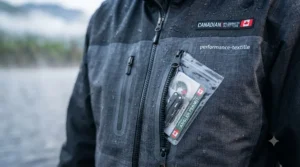
Problem → Solution: Fixing the Five Most Common Rain Suit Complaints
Problem: Water creeping in at the cuffs during casting. This happens when hook-and-loop cuffs are worn loose or when a jacket lacks an internal gasket. Suits like the AFTCO Barricade with its “Double Dry” cuff system and the Mustang Survival Taku with neoprene wrist gaskets solve this at the design level; on other suits, cinching the cuff tighter and layering a glove gauntlet over the sleeve closes the gap.
Problem: Fogging or clamminess despite a “waterproof” rating. This is almost always a breathability mismatch, not a waterproofing failure — check the g/m²/24hr MVTR rating, not just the mm waterproof number, and size down layers underneath rather than the shell itself.
Problem: Zipper failure after one season. Covered above — proactive zipper wax maintenance prevents most of this before it starts.
Problem: Pockets that dump gear when kneeling to net a fish. This is a design flaw specific to non-fishing rain gear repurposed for angling; the HUK Pro Series‘ zippered, angled thigh pockets solve exactly this problem, which is worth the price premium for anglers who net fish constantly.
Problem: Suit performs fine in rain but soaks through from boat spray. Overhead rain and horizontal spray stress a suit differently. If spray is your bigger issue, prioritize hood and collar design (the Simms Challenger‘s brimmed hood) or kayak-specific sealing (the NRS Riptide‘s overskirt) over raw waterproof rating.
How to Choose a Fishing Rain Suit
Choosing the right fishing rain suit comes down to matching fabric technology and design features to your actual fishing conditions, not chasing the highest number on a spec sheet. Here’s the framework, step by step:
- Identify your primary water type first. Saltwater coastal fishing demands corrosion-resistant hardware and UV-stable fabric; freshwater lake and river fishing has more flexibility.
- Match the waterproof rating to your rain exposure. A 10,000mm rating handles moderate rain fine; sustained heavy downpours or offshore spray call for 15,000mm or higher.
- Weight breathability against your activity level. Anglers who cast constantly need higher MVTR ratings than anglers fishing from a stationary position.
- Check pocket placement against your actual gear. If you carry pliers, a phone, and tackle, prioritize suits with dedicated, angled pockets over generic zippered ones.
- Consider layering compatibility. Waders, insulated liners, and boots all interact with a suit’s cut — the Simms Challenger‘s extra length exists specifically for this reason.
- Factor in realistic maintenance habits. Laminate shells need periodic DWR reproofing; PVC-coated suits like the Grundens Brigg 40 need far less upkeep but sacrifice breathability.
- Set a budget based on days-per-season, not sticker price alone. A suit used 5 days a year has a very different cost-per-use calculation than one used 80 days a year.
Common Mistakes When Buying a Fishing Rain Suit
The single biggest mistake anglers make is buying based on waterproof rating alone while ignoring breathability entirely. A 30,000mm suit with poor MVTR will still leave you soaked — just from the inside instead of the outside. The second most common error is buying a size based on a normal clothing size rather than accounting for layers; fishing rain suits are meant to go over a base layer or two, and a snug fit defeats the purpose. Reviewers across nearly every product in this guide flag sizing as a recurring point of confusion, which is why checking a brand’s specific size chart matters more than assuming standard sizing carries over.
A third mistake is underestimating zipper quality. Cheap zippers are the leading cause of premature suit failure across every price tier, and it’s worth specifically checking whether a suit uses YKK AquaGuard or an equivalent marine-grade zipper before purchase. Finally, many anglers skip checking whether the jacket and bib are sold as a genuinely matched system — mixing brands can leave gaps at the waist where the two pieces don’t overlap properly, which is exactly where water finds its way in.
Fishing Rain Suit vs Regular Rain Gear
| Feature | Fishing-Specific Rain Suit | Generic Rain Jacket/Poncho |
|---|---|---|
| Waterproof rating | Typically 10,000–30,000mm | Often unlisted or under 5,000mm |
| Pocket design | Angled, tackle-specific (pliers, hooks) | Generic, not built for gear access |
| Hardware | Corrosion-resistant, kill-switch D-rings | Standard zippers, no marine hardware |
| Mobility for casting | Articulated shoulders, stretch panels | Boxy fit, restricts casting motion |
| Boat-deck durability | Reinforced knees/seat, abrasion panels | Not built for kneeling or deck abuse |
| Best For | Regular anglers, boat or kayak fishing | Occasional, non-water-adjacent use |
The gap here is bigger than most first-time buyers expect. A generic rain jacket might handle a walk to the car in a downpour, but the combination of sustained exposure, constant arm motion from casting, and contact with wet gear and fish means fishing-specific suits from brands like AFTCO and HUK are solving a genuinely different engineering problem than a commuter raincoat. The pocket and hardware differences alone — dedicated plier pockets, kill-switch D-rings, marine-grade zippers — reflect design input from people who actually fish, not adapted outdoor-industry templates.
🔍 Compare Today’s Top Fishing Rain Suits Before You Head Out
Take your next trip from miserable to memorable with gear built for the job. Click through to check current pricing and availability on any suit above — the right rain gear turns a washed-out weekend into one of your best days on the water. 🎣☔
What to Expect: Real-World Performance in Canadian Conditions
Specs on a tag only tell part of the story — what actually matters is how a suit performs across a Great Lakes cold front, a coastal BC squall, or a prairie thunderstorm rolling in fast. In sustained moderate rain (the most common Canadian scenario from spring through fall), any suit rated 10,000mm or higher with taped seams will keep you genuinely dry for a full day, assuming the hood and cuffs are properly cinched. Where suits diverge sharply is in wind-driven rain and boat spray, which hits at an angle rather than straight down — this is where hood brim design (strong on the Simms Challenger) and cuff sealing (strong on the Mustang Survival Taku) start to matter more than the raw waterproof number.
Cold-weather performance depends heavily on layering compatibility rather than the shell alone. A three-layer laminate suit like the AFTCO Barricade breathes well enough to layer a fleece mid-layer underneath without overheating, while the Grundens Brigg 40‘s PVC construction traps heat more aggressively — genuinely useful on a frigid November morning, less so casting hard through a warm afternoon. On a saltwater coast, expect any suit’s DWR coating and zipper hardware to degrade faster than the same gear used exclusively in freshwater, which is precisely why the Mustang Survival Taku‘s UV- and salt-resistant fabric selection earns its price premium for anglers fishing tidal water regularly.
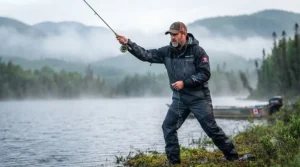
Tackle Pocket Design: What Actually Works
Tackle pocket design sounds like a minor detail until you’re fumbling for pliers with a fish half-landed and rain running down your collar. The best-designed pockets on a fishing rain suit share a few consistent traits: they’re angled to match the natural motion of a reaching hand rather than sitting flat on the torso, they use water-shield flaps rather than exposed zippers in high-splash zones, and they include at least one dedicated, correctly sized slot for pliers or a multitool rather than forcing you to jam them into a generic pocket where they snag on the zipper. The HUK Pro Series demonstrates this best across the lineup, with cargo-style thigh pockets specifically sized and angled for one-handed access mid-cast.
Reviewers consistently note that pocket count matters less than pocket placement — a suit with six generic pockets can still feel disorganized on the water, while a suit with four well-placed ones feels effortless. Internal chest pockets for a license or keys, kept separate from the exterior tackle-access pockets, are a small design choice that shows up across the better suits in this guide, including both the HUK Pro Series and the AFTCO Barricade, and it’s worth checking for specifically if you’re the type of angler who’s constantly digging through layers to find a fishing licence at a dock check.
Saltwater Resistant Fishing Gear: What Matters
Saltwater resistance isn’t a single feature — it’s a combination of fabric UV stability, hardware corrosion resistance, and coating durability that all degrade at different rates under coastal exposure. Standard metal zippers pit and seize within a season or two of regular saltwater contact, which is why marine-grade suits specifically spec composite or coated zippers like YKK AquaGuard, present on both the AFTCO Barricade and the Mustang Survival Taku. Fabric face material matters too: polyester generally holds UV resistance better than nylon over time, which is relevant for anglers fishing exposed coastal water where sun exposure compounds saltwater’s effect on fabric coatings.
Rinsing gear with fresh water after every saltwater outing remains the single highest-impact maintenance habit for extending a suit’s functional life, regardless of which brand you choose. For anglers fishing Atlantic or Pacific coastal water regularly, the Mustang Survival Taku‘s purpose-built Marine Spec SP fabric reflects genuine engineering for this exact use case rather than a freshwater suit with a saltwater label slapped on — a distinction worth paying attention to, since not every “saltwater safe” claim in the fishing apparel market holds up equally well under real coastal use.
🌊 Find the Right Saltwater-Ready Suit for Your Coast
Whether you’re running charters off Vancouver Island or casting from a Maritime wharf, gear built for genuine saltwater exposure pays for itself in fewer replacement cycles. Compare current options and check availability today. ⚓
Long-Term Cost & Maintenance
Thinking about a fishing rain suit purely as an upfront cost misses the more useful number: cost per season of actual use. A Frogg Toggs Pilot II at around C$150–C$280 that needs replacing every one to two seasons under heavy use works out to a genuinely comparable annual cost to a HUK Pro Series at C$1,300–C$1,500 that lasts five-plus seasons with proper maintenance — the math depends entirely on how many days a year you actually fish in it. Occasional anglers rarely recoup a premium suit’s higher upfront cost; anglers fishing 50+ days a season very often do.
Maintenance costs are modest across the board but not zero: a bottle of DWR reproofing spray runs a relatively small amount and should be applied roughly once a season for regular users. Zipper wax and the occasional seam-tape touch-up add marginal cost. The real long-term expense driver is neglect — a suit stored wet, compressed, or salt-crusted degrades years faster than one properly rinsed and hung dry after each use, regardless of how much was spent on it initially.
Safety, Regulations & Compliance for Canadian Anglers
Rain suits are comfort and performance gear, but they intersect directly with a genuinely serious safety issue: cold-water immersion. Transport Canada’s Passport for Anglers and Hunters notes that sudden cold-water exposure can paralyze muscles and trigger breathing difficulty within moments, and that hypothermia remains the next serious danger for anyone who ends up in the water — a rain suit does not replace a properly worn, Canadian-approved personal flotation device, and Transport Canada regulations require an appropriately sized PFD or lifejacket for every person aboard any watercraft.
Some fishing-specific PFDs are designed to be worn comfortably underneath or integrated with a rain suit, offering greater arm freedom for casting than a bulky standard vest, and cold-water-rated PFDs with added thermal protection are worth prioritizing for anyone fishing water below 15°C — which covers most of Canada’s fishable water for a significant part of the season. Beyond flotation, reflective piping and high-visibility colours, present on suits like the HUK Pro Series and the AFTCO Barricade, genuinely improve visibility to other boaters during low-light dawn and dusk fishing, when a meaningful share of recreational boating incidents occur. None of the seven suits in this guide are a substitute for proper safety equipment — they’re a complement to it.
FAQ
❓ What waterproof rating do I actually need for fishing?
❓ Can I wear a regular raincoat while fishing instead?
❓ How long should a good fishing rain suit last?
❓ Is a fishing rain suit necessary for kayak fishing?
❓ Do cheaper fishing rain suits actually keep you dry?
Conclusion
There’s no single best fishing rain suit — there’s only the best one for the water you actually fish, the number of days you’re out there, and how much you’re willing to spend to stay comfortable when the forecast turns against you. Budget-conscious weekend anglers get real, honest protection from the Frogg Toggs Pilot II. Anglers who need gear that survives genuine abuse turn to the Grundens Brigg 40 / Herkules 16 pairing. Tournament and active casters land on the AFTCO Barricade or the pocket-optimized HUK Pro Series, freshwater guides lean toward the wader-friendly Simms Challenger, coastal and saltwater anglers get purpose-built protection from the Canadian-made Mustang Survival Taku, and kayak anglers finally get a genuinely tailored solution in the NRS Riptide.
Whichever suit you land on, remember that waterproof fishing clothes are only as good as their maintenance — rinse them, dry them properly, and reproof them once a season, and any of these seven suits will keep delivering long after the rain has stopped being the reason you’re out there at all.
🎣 Gear Up Before the Next Front Rolls In
Don’t let the forecast decide whether you fish this weekend. Check current pricing and availability on the fishing rain suit that matches your water, your budget, and your season. ⚡☔
Recommended for You
- Best Rain Suit 2026: 7 Top Picks Reviewed for Canadian Riders
- 7 Best Rain Pants to Wear Over Clothes in Canada (2026 Guide)
- 7 Best Packable Rain Pants Canada 2026: Lightweight & Reliable
Disclaimer: This article contains affiliate links. As an Amazon Associate, I earn from qualifying purchases. If you purchase products through these links, we may earn a small commission at no additional cost to you.
✨ Found this helpful? Share it with your friends! 💬🤗
